

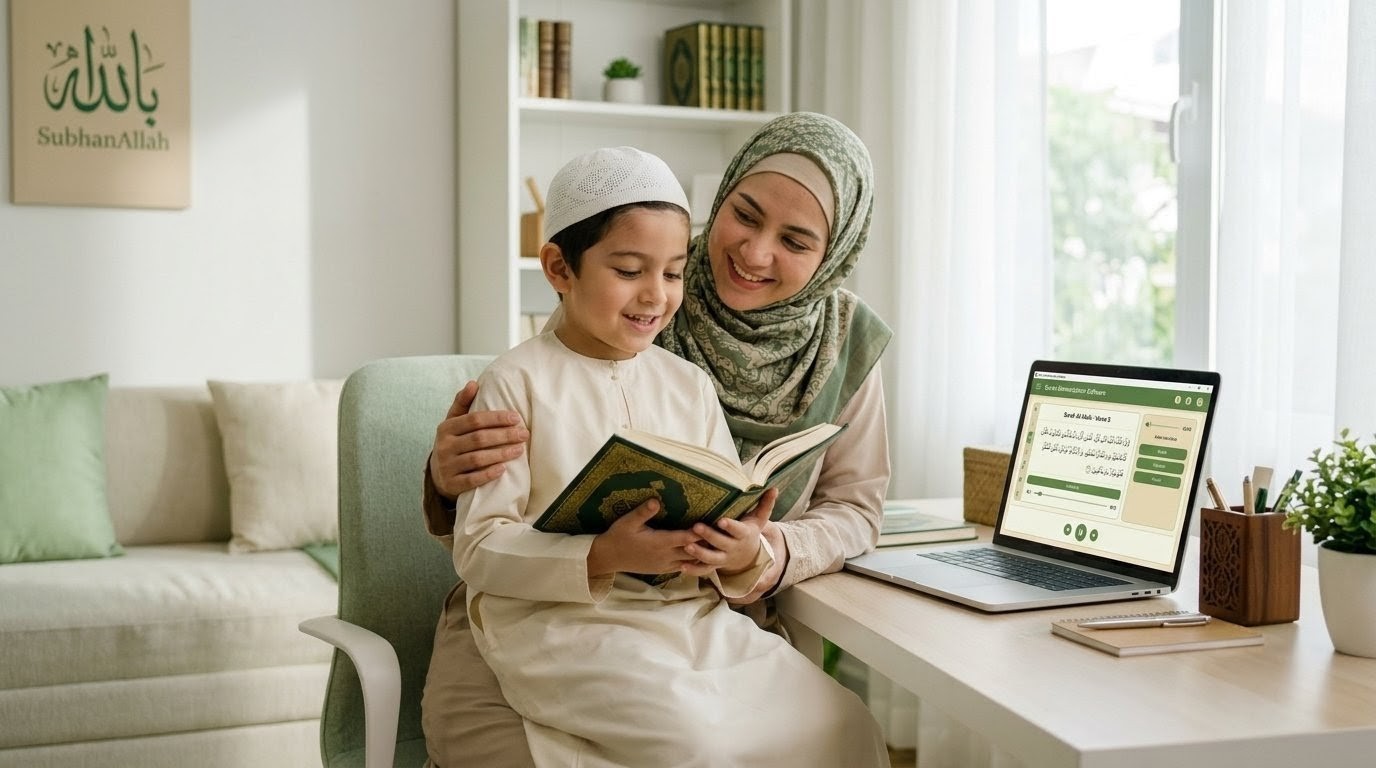
How can you encourage your children to read and memorize the Quran while living in a non-Muslim country where Islamic values are not part of everyday life? The answer is that it starts with creating a positive relationship with the Quran at home. Children do not usually develop a love for the Quran because they are forced to study it. They develop that love when they see its importance in daily life, receive consistent encouragement, and learn from teachers who understand their language, culture, and learning needs.
For many Muslim parents living in countries like the United States, Canada, the United Kingdom, or Australia, raising children with a strong Islamic identity can feel challenging. Children spend most of their day at school, and their friends may come from different religious backgrounds. Arabic is often not spoken at home or in the community, and finding qualified Quran teachers nearby may also be difficult. These challenges are real.
However, they do not make Quran education impossible. With the right environment, the right habits, and proper guidance, children can build a strong relationship with the Quran no matter where they live. At Taj Academy, we work with Muslim families around the world and understand these everyday challenges. Our experienced Egyptian teachers help children learn the Quran in a way that fits their age, language level, and family routine while making online learning both practical and enjoyable.
Why Living In A Non-Muslim Country Creates Different Challenges For Quran Learning
For many Muslim families, the environment children grow up in plays an important role in their Islamic education. In Muslim-majority countries, daily life naturally reinforces many Islamic values and practices. Children regularly hear the Adhan, see people going to the mosque, celebrate Islamic occasions with their communities, and often have friends who are also learning the Quran.
For families living in countries such as the United States, Canada, or the United Kingdom, the learning environment is often very different. This does not make Quran memorization impossible, but it does mean that parents usually need to create an Islamic learning atmosphere intentionally instead of relying on the surrounding community.
At Taj Academy, we work with many English-speaking families around the world and understand the unique challenges they face while helping their children stay connected to the Quran.
Common Challenges For Muslim Families Living Abroad
The table below highlights some of the differences families may experience and practical ways to support consistent Quran learning.
| Challenge | How It Can Affect Quran Learning | Practical Solution |
|---|---|---|
| Limited Daily Arabic Exposure | Children may hear Arabic only during scheduled Quran lessons, reducing regular language familiarity. | Include short daily Quran listening sessions at home outside class time. |
| Busy School Schedules | School activities, homework, and extracurricular programs can leave less time for Quran study. | Create a consistent weekly Quran schedule that fits naturally around school routines. |
| Fewer Muslim Peers | Children may have fewer friends who share similar Quran learning goals, reducing motivation through positive peer influence. | Encourage participation in online Islamic learning communities and group Quran classes. |
| Less Visible Islamic Environment | Daily reminders of Islamic practices may be less common than in Muslim-majority societies. | Establish simple family routines such as reading Quran together or beginning the day with a short recitation. |
| Balancing Multiple Cultures | Children often switch between different languages and cultural environments every day. | Help children see Quran learning as a natural part of their identity through consistent family support and encouragement. |
Why Parents Play An Even Bigger Role
When children grow up in a non-Muslim country, parents become one of the strongest influences on their Islamic education. Simple habits can have a lasting impact, such as maintaining regular lesson times, celebrating Quran milestones, encouraging daily revision, and showing enthusiasm for Islamic learning at home.
These consistent actions help children view Quran study as an important and enjoyable part of everyday life rather than just another weekly activity.
Small Daily Habits Create Long-Term Success
Living outside a Muslim-majority country does not limit a child’s ability to become a successful Quran student.
In many cases, children thrive because their families intentionally build strong learning routines and remain committed to consistent Islamic education.
At Taj Academy, we partner with parents to make that journey easier by providing structured online Quran learning designed specifically for English-speaking students around the world. With the right support, regular guidance, and a positive home environment, children can develop a lifelong connection with the Quran no matter where they live.
Why Children Learn The Quran Best When It Feels Like A Natural Part Of Daily Life
Children learn most effectively when learning becomes part of their everyday experiences instead of feeling like an isolated task. When Quran study is presented only as another lesson that begins after school and homework, children may view it as an additional responsibility rather than a meaningful part of their lives.
A more effective approach is to help children experience the Quran naturally throughout the day. This does not require long study sessions or complicated routines. Instead, small moments of Quran-centered family interaction can gradually build a lasting connection with the Book of Allah.
At Taj Academy, we encourage parents to create a home environment where Quran learning extends beyond the online classroom. When children regularly experience the Quran in positive family settings, their motivation often grows naturally.
Simple Ways To Make The Quran Part Of Everyday Family Life
The goal is not to add more work to a family’s schedule, but to weave the Quran into normal daily routines in enjoyable and meaningful ways.
| Daily Family Habit | How It Helps Children Connect With The Quran |
|---|---|
| Read A Few Verses Together | Short family recitation sessions help children see Quran reading as a shared family activity rather than an individual assignment. |
| Listen To Quran During Everyday Activities | Playing beautiful recitation while driving or during quiet moments increases children’s familiarity with the sound and rhythm of the Quran. |
| Discuss Quran Stories Naturally | Talking about the lessons and values found in Quran stories during meals or family conversations helps children relate the Quran to real life. |
| Celebrate Memorization Milestones | Recognizing a child’s progress, even for small achievements, builds motivation and encourages continued effort. |
| Invite Children To Ask Questions | Allowing children to ask about verses, meanings, or Islamic topics develops curiosity and makes learning more interactive. |
| Begin Or End The Day With Quran | A short recitation in the morning or before bedtime creates a peaceful daily routine centered around the Quran. |
Building Positive Emotional Connections
Children often remember how learning made them feel more than the lesson itself. When Quran learning is connected with family time, encouragement, kindness, and celebration, children begin to associate the Quran with feelings of comfort, belonging, and happiness.
These positive emotional experiences increase motivation and help children return to Quran learning with enthusiasm instead of reluctance.
How Taj Academy Helps Families Build Consistent Quran Habits
Many parents know what they want for their children but struggle to build a consistent routine. Busy work schedules, school activities, and different time zones often make regular Quran lessons difficult.
At Taj Academy, we help families create realistic learning plans that fit their daily lives. Our teachers work closely with parents to develop routines that children can actually maintain.
Students who want structured memorization support can begin with our Quran memorization course, where every lesson includes new memorization, revision, and pronunciation correction in a balanced way. Consistency is more valuable than intensity.
A routine that continues for years will always produce better results than a routine that lasts only a few weeks.
Why Encouragement Works Better Than Pressure
Every parent wants their child to succeed, but this desire can sometimes unintentionally turn into pressure.
Children quickly recognize the difference between encouragement and constant criticism. While encouragement nurtures confidence, excessive pressure often creates a fear of making mistakes. When children feel safe and supported, they are more likely to ask questions, participate actively, and embrace challenging lessons with confidence.
Parents can foster a positive learning environment by:
- Praising effort rather than focusing solely on results.
- Celebrating small improvements and milestones.
- Avoiding comparisons with siblings or friends.
- Remaining patient during difficult stages of learning.
- Showing appreciation for consistency and perseverance.
Children who enjoy the learning process are more likely to develop a lifelong love of learning. Creating positive emotions around learning the Quran is one of the greatest gifts parents can offer their children.
Why Online Quran Learning Has Become a Practical Solution for Muslim Families
In the past, many Muslim families relied primarily on local Islamic centers for Quran education. While these institutions continue to play an important role, online learning has created new opportunities that make Quran education more accessible and convenient than ever before.
Today, parents can choose qualified Quran teachers regardless of their location, allowing children to receive high-quality instruction from the comfort and familiarity of their own homes. Online learning also offers greater scheduling flexibility, making it easier for families to fit Quran lessons into their daily routines.
Taj Academy, the Best Online Quran academy, helps families connect with experienced and qualified Quran teachers without the challenges of travel or the limitations of local resources. This approach enables parents to remain actively involved in their children’s learning while providing them with direct access to authentic Quran education.
For many families, the combination of convenience, flexibility, and expert instruction has made it much easier to maintain consistent Quran learning and build a lasting connection with the Quran.
Why Building a Love for the Quran Is More Important Than Finishing Quickly
Many parents measure progress by the number of Surahs their children memorize. While memorization is an important achievement, developing a genuine love for the Quran is even more valuable.
A child who enjoys reading and learning the Quran is far more likely to maintain that connection throughout adulthood. In contrast, a child who memorizes under constant pressure may lose motivation once a specific goal has been reached. For this reason, Taj Academy emphasizes steady, meaningful learning rather than rushing through lessons. We believe the Quran is not simply something to complete or finish—it is a lifelong companion that offers guidance, comfort, and spiritual strength in every stage of life.
A lasting relationship with the Quran begins with positive learning experiences during childhood. When children associate Quran learning with encouragement, confidence, and joy, they are much more likely to remain connected to the Quran for the rest of their lives.
How To Help Your Child Read The Quran Even If Arabic Is Not Their First Language
Many Muslim parents worry that their children speak English every day while using Arabic only during Quran lessons. Because Arabic is not part of their daily conversations, parents sometimes wonder whether their children will ever become confident Quran readers.
The good news is that thousands of children around the world successfully learn to read the Quran even though Arabic is their second language. Success does not depend on speaking Arabic at home every day. It depends on following a learning path that matches the child’s age, language background, and reading ability.
At Taj Academy Official Website, we specialize in teaching English-speaking students, helping them develop the skills they need to read the Quran with confidence through a structured and gradual approach.
Practical Steps To Help Your Child Read The Quran Successfully
Instead of expecting children to master everything at once, parents can support steady progress by focusing on one learning stage at a time.
| Step | How It Supports Quran Learning |
|---|---|
| Build A Consistent Learning Routine | Regular lesson times help children develop steady learning habits without feeling overwhelmed. |
| Choose Age-Appropriate Lessons | Lessons designed for young learners make Arabic easier to understand and more enjoyable to practice. |
| Allow Children To Progress At Their Own Pace | Every child learns differently. Steady progress is more valuable than rushing through lessons. |
| Practice Regularly Between Classes | Short daily practice sessions help children remember what they learned during live lessons. |
| Learn With Qualified Teachers | Expert guidance helps children develop accurate reading skills while receiving encouragement throughout the learning journey. |
| Celebrate Progress Along The Way | Recognizing small achievements helps children stay motivated and confident as their skills improve. |
Why Noor Al Bayan Is The Perfect Starting Point For Young Children
Many parents begin searching immediately for Quran memorization classes because they want their children to memorize the Quran as early as possible.
However, before children begin memorization, they first need a learning method that introduces Arabic in a simple, organized, and child-friendly way.
At Taj Academy, our Arabic course for English speaking students is built around the Noor Al Bayan Course, which prepares young learners for future Quran study through a structured reading program designed especially for beginners.
Rather than introducing advanced material immediately, the Noor Al Bayan method allows children to develop essential reading skills through gradual and carefully planned lessons.
What Children Learn In The Noor Al Bayan Course
The table below shows the main skills children develop before moving toward Quran reading and memorization.
| Learning Skill | Why It Is Important |
|---|---|
| Recognizing Arabic Letters Correctly | Helps children identify every letter confidently during reading practice. |
| Understanding Short And Long Vowel Sounds | Teaches children how vowel changes affect pronunciation while reading Arabic words. |
| Reading Connected Arabic Words | Develops the ability to move smoothly from individual letters to complete words. |
| Building Early Reading Fluency | Encourages children to read simple Arabic words with increasing confidence and accuracy. |
| Learning Correct Pronunciation From The Beginning | Helps children develop clear and accurate reading habits before starting Quran recitation. |
A Strong Beginning Leads To Easier Quran Learning
When children first develop comfortable Arabic reading skills, they often approach Quran lessons with greater confidence and less hesitation.
Instead of struggling with unfamiliar reading patterns, they can focus their attention on understanding and reciting the Quran correctly. At Taj Academy, we believe that every child deserves a strong beginning.
By building the right foundation through our Arabic course for English speaking students and the Noor Al Bayan Course, we help children take their first steps toward lifelong Quran learning with confidence, consistency, and joy.
Why Interactive Lessons Keep Children Interested For Longer
Young children learn best when they are actively involved in the lesson rather than simply listening for long periods. Unlike adults, children usually have shorter attention spans and stay focused for longer when they are encouraged to participate throughout the learning process.
A successful lesson should give children regular opportunities to think, respond, and interact. When students become active participants instead of passive listeners, they remain more attentive and are more likely to remember what they learn.
At Taj Academy, our Noor Al Bayan Course is designed with interactive teaching strategies that keep children engaged from the beginning of each lesson until the end.
How Interactive Learning Helps Young Students
The table below explains how active participation improves the learning experience for children.
| Interactive Teaching Method | How Children Participate | Learning Benefit |
|---|---|---|
| Reading Aloud During Class | Children read short exercises while the teacher provides guidance. | Builds confidence and encourages children to participate regularly. |
| Answering Simple Questions | Teachers ask age-appropriate questions throughout the lesson instead of waiting until the end. | Keeps children thinking actively and improves concentration. |
| Group Pronunciation Practice | Students repeat sounds and words together with the teacher. | Creates an enjoyable classroom atmosphere while encouraging participation. |
| Interactive Reading Activities | Children take turns reading and responding during different lesson activities. | Maintains attention by changing the pace of the lesson regularly. |
| Positive Teacher Encouragement | Teachers celebrate effort as well as progress, helping children stay motivated. | Encourages children to continue participating without worrying about making mistakes. |
Why Participation Improves Learning
Children remember more when they actively use new skills instead of only observing them. Interactive lessons give students frequent opportunities to speak, listen, respond, and practice throughout the class. This continuous participation helps children stay mentally engaged while making learning feel enjoyable rather than repetitive.
As a result, many children look forward to their lessons because they feel involved from beginning to end.
Why Learning With Qualified Egyptian Teachers Gives Children A Strong Start
A child’s first teacher often has a lasting influence on how they feel about learning Arabic and the Quran. The early learning experience can shape confidence, curiosity, and motivation for many years.
For children from English-speaking families, having a teacher who understands both the Arabic language and the challenges faced by non-Arab learners can make a significant difference.
At Taj Academy, our students learn with qualified Egyptian teachers who have extensive experience teaching children from different countries and language backgrounds.
Why Our Teachers Help Children Learn More Comfortably
The table below highlights some of the advantages of learning with qualified Egyptian teachers at Taj Academy.
| Teacher Advantage | How It Helps Young Learners |
| Experience Teaching English-Speaking Students | Teachers understand the common learning difficulties children face when Arabic is a new language. |
| Clear English Communication | Lessons can be explained in simple English whenever additional clarification is needed. |
| Patient Teaching Style | Children are given time to learn at their own pace without feeling rushed. |
| Supportive Learning Environment | Teachers encourage children to ask questions and participate confidently during every lesson. |
| Structured Lesson Guidance | Every lesson follows an organized learning plan that helps children progress step by step. |
Building Confidence From The Very First Lesson
At Taj Academy, we believe that children should never feel afraid of making mistakes while learning. Instead, they should feel supported, encouraged, and confident enough to keep trying.
Our qualified Egyptian teachers create a welcoming classroom environment where children feel comfortable asking questions, practicing new skills, and celebrating every stage of their progress.
When students begin their learning journey with the right guidance, they build confidence that continues to support them throughout their future Quran education.
Why Every Child Learns at a Different Pace
It is natural for parents to compare their children with siblings, cousins, or classmates. However, these comparisons often create unnecessary pressure and can discourage children from enjoying the learning process.
The reality is that every child learns at a different pace. Some become confident Quran readers quickly, while others need additional time and practice to build the same skills. Both experiences are completely normal and should be respected.
At Taj Academy, our teachers carefully monitor each student’s progress and adapt their teaching methods to meet the child’s individual needs and abilities. Rather than encouraging children to keep up with someone else’s pace, we focus on helping every student build confidence and make steady, meaningful progress.
Quran learning should never feel like a competition. Consistent growth, no matter how gradual, is far more valuable than rushing through lessons.
How Parents Can Create a Quran-Friendly Home Without Making It Feel Like School
Although children spend time with their Quran teacher each week, they spend far more of their lives at home. For this reason, the home environment plays a vital role in strengthening their connection with the Quran.
Parents do not need to recreate a classroom at home. Instead, simple daily habits can make Quran learning feel like a natural part of family life. For example, families can:
- Play Quran recitation during car rides or while traveling.
- Keep a child-friendly Mushaf in an easily accessible place.
- Read a few verses together before bedtime.
- Encourage children to share what they learned after each lesson.
- Include Islamic values and Quranic teachings in everyday family conversations.
These small but consistent practices help children see the Quran not as something limited to lesson time, but as a meaningful and lasting part of their daily lives.
Students who continue their learning journey later can also benefit from programs such as the Best Online Tajweed Course to strengthen their recitation after developing solid reading skills.
Why Taj Academy Supports Families Beyond the Classroom
Teaching the Quran involves much more than delivering online lessons. Families also need guidance, encouragement, and a supportive learning environment they can rely on throughout their children’s educational journey.
At Taj Academy, we believe that parents are essential partners in Quran education. Our teachers maintain clear communication with families, carefully monitor each student’s progress, and provide personalized recommendations based on the child’s individual needs and development.
Having worked with students from diverse backgrounds around the world, we understand the unique challenges many Muslim families face, particularly those living in non-Muslim countries. This experience allows us to provide practical support that extends beyond the virtual classroom.
Our mission is not simply to teach children how to read the Quran. We strive to help families nurture a lifelong connection with the Quran, enabling children to grow into confident, knowledgeable, and practicing Muslims with a strong foundation in their faith.
Frequently Asked Questions
1. At what age should my child start learning the Quran?
There is no single perfect age, but many children can begin learning basic Arabic reading between the ages of 4 and 6, depending on their readiness. The most important factor is choosing lessons that match the child’s age and learning ability. Starting with a strong reading foundation often makes Quran learning much easier later.
2. My child does not speak Arabic. Can they still learn to read and memorize the Quran?
Yes. Many Muslim children living in non-Muslim countries grow up speaking English or another language at home and still become successful Quran readers and memorizers. With qualified teachers, step-by-step instruction, and regular practice, children can develop strong Arabic reading skills even if Arabic is not their first language.
3. How can I motivate my child if they lose interest in Quran lessons?
Instead of forcing longer study sessions, focus on making learning enjoyable. Set small goals, celebrate progress, praise effort, and keep a consistent routine. Children are usually more motivated when they feel successful and supported rather than pressured to memorize quickly.
4. Why do many Muslim families choose Taj Academy for their children?
Many families choose Taj Academy because it understands the needs of children growing up outside Muslim countries. Students learn with qualified Egyptian teachers through live online classes, personalized lesson plans, flexible schedules, and interactive teaching methods that help children build confidence while developing a lasting connection with the Quran.
5. Can my child continue learning after becoming confident in reading the Quran?
Yes. Learning to read the Quran is only the beginning. After building a strong foundation, children can continue with Quran memorization, Tajweed, advanced recitation, and other Islamic studies. A step-by-step learning journey helps children continue improving while strengthening their understanding and love of the Quran throughout their lives.