

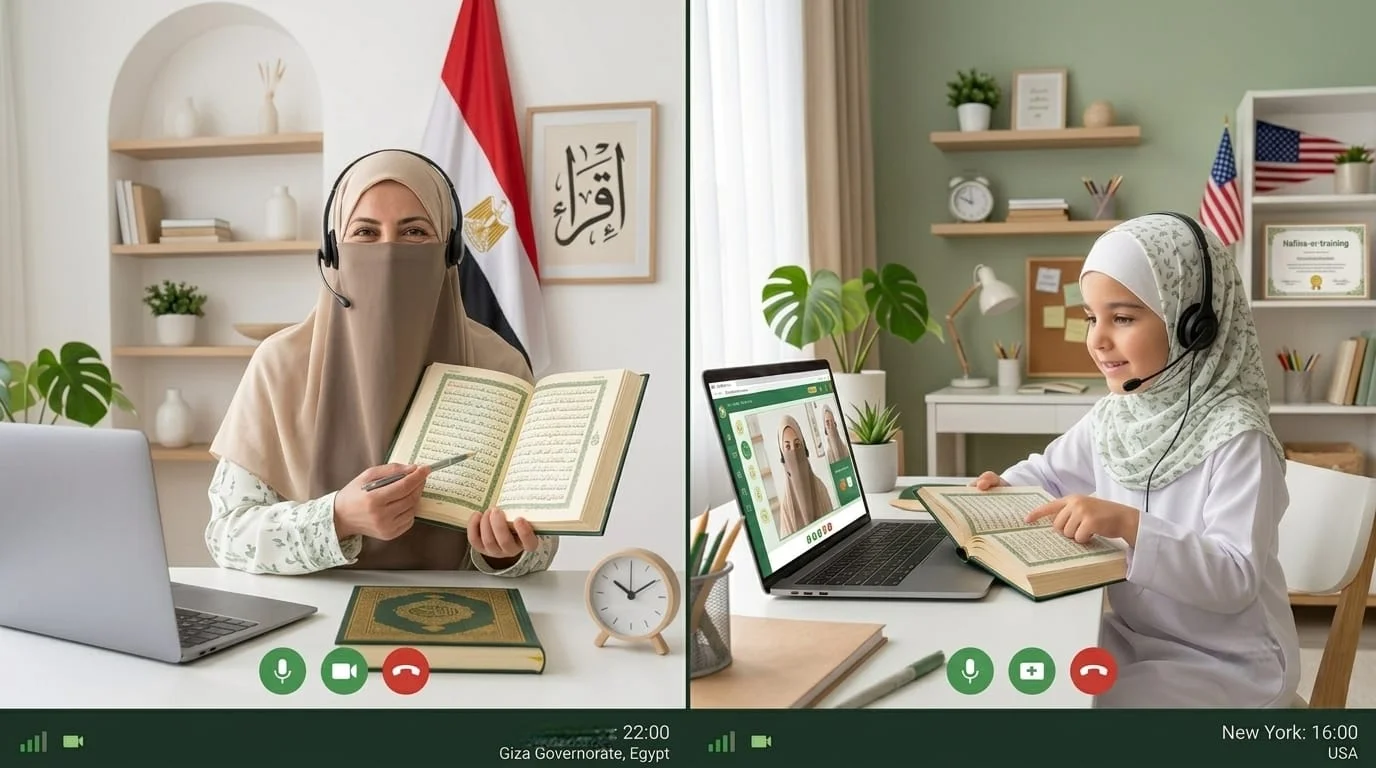
Online Quran teaching is changing the way Islamic knowledge moves around the world. A Quran teacher in Egypt or another Muslim country can now teach students living thousands of miles away in the United States, Canada, Australia, the United Kingdom, and other countries. The teacher may never meet the student in the same physical room, yet a strong educational relationship can still develop through regular live lessons, conversation, correction, and practice.
This change is bigger than simply moving Quran lessons from a mosque to a computer screen. It is creating a new global Islamic knowledge economy where teachers can share their knowledge across borders, families can access qualified instructors regardless of location, and students can learn from people who may have spent years studying Quran recitation, Tajweed, Arabic, and Islamic sciences.
For a Muslim family living in New York, Toronto, Sydney, or London, geography no longer has to decide who teaches their child the Quran. A family can look for the right teacher based on knowledge, experience, communication skills, teaching style, and availability instead of choosing only from people who live nearby.
This is one of the most important changes created by online Quran teaching.
The question is no longer simply, “Where is the nearest Quran teacher?” It is becoming: “Which teacher is right for this student?”
Why A Child’s Quran Teacher Can Influence The Entire Learning Journey
A teacher may only spend two or three hours each week with a child. That may sound like a small amount of time.
But the emotional impact can be much larger.
Children remember teachers who:
- Encouraged them.
- Were patient when they struggled.
- Celebrated their achievements.
- Helped them when they found a difficult verse.
- Made them feel confident during learning.
Why Teacher Selection Matters
| Teacher Quality | Impact On The Child |
|---|---|
| Quranic knowledge | Provides accurate instruction. |
| Patience | Helps children continue when learning becomes difficult. |
| Communication skills | Makes lessons easier to understand. |
| Understanding of children | Helps the teacher respond to different personalities. |
| Encouragement | Builds motivation and confidence. |
A technically knowledgeable teacher who cannot communicate effectively with children may not produce the same results as a knowledgeable teacher who also understands how to motivate them.
Knowledge and teaching ability need to work together.
How Taj Academy Fits Into The Global Quran Education Economy
Taj Academy is an example of how this new model works.
The academy connects students with experienced Egyptian Quran teachers who graduated from Al-Azhar University.
How The Model Works
- Students can learn from experienced Egyptian teachers.
- Families can access Quran education from different countries.
- Students can learn from the comfort of home.
- Parents can choose lesson times that work with school and work schedules.
- Students can receive individual attention.
- Teachers can focus on the student’s actual level.
This is the practical side of the global Islamic knowledge economy.
- Knowledge travels.
- Teachers reach new communities.
- Students gain access to specialized instruction.
Why The Global Islamic Knowledge Economy Is Not About Replacing Mosques
Online education should not be understood as a replacement for the mosque.
A mosque provides important community experiences, while online education provides different forms of access.
| Mosques | Online Education |
|---|---|
| Community life | Access |
| Meeting other Muslims | Flexibility |
| Children’s activities | Specialized instruction |
| Family events | Personalized learning |
| Praying together | Online teacher access |
A healthy Muslim family may benefit from both.
For example:
- A child can attend the mosque on Friday and study Quran online during the week.
- An adult can join a local study circle while taking private online recitation lessons.
These two forms of learning can support each other.
The Economic Side Of This New Model
Traditional education requires physical infrastructure.
Traditional Requirements
- Classrooms.
- Physical learning centers.
- Transportation.
- Local facilities.
Online education reduces some of these barriers.
- Teachers do not need to build classrooms in every country.
- Students do not need to travel internationally to access a teacher.
- Educational services can cross borders more easily.
However, online education still requires:
- Teacher training.
- Academy administration.
- Technology investment.
The model simply allows educational services to cross borders much more easily.
Why This Matters For Teachers In Egypt
Egypt has a long history of Quran education and Islamic scholarship.
There are many teachers with experience in:
- Quran recitation.
- Arabic.
- Tajweed.
- Islamic studies.
Previously, a teacher’s potential student base could be limited by geography.
Online education changes that.
A Qualified Teacher In Egypt Can Teach:
- A child in California.
- A teenager in New York.
- An adult in Sydney.
- A family in London.
The teacher’s knowledge becomes globally accessible.
For properly qualified teachers supported by professional academies, this creates a wider educational role.
They are no longer serving only the neighborhood around them. They can become part of a worldwide learning network.
Why Students Benefit From Cross-Border Quran Education
Students can learn from teachers who come from cultures where Quran education is deeply integrated into everyday life.
Students May Gain Access To:
- Authentic Arabic pronunciation.
- Traditional recitation methods.
- Broader Islamic educational traditions.
- Cultural connections that their local environment may not always provide.
This does not mean Western Muslim communities lack Islamic knowledge.
It simply means online education allows different communities to share knowledge.
Online Quran Teaching And The Future Of Islamic Education
The global Islamic knowledge economy is still developing.
Technology May Continue To Improve:
- Video platforms.
- Digital whiteboards.
- Artificial intelligence for pronunciation practice.
- Learning systems for tracking student progress.
- Mobile technology for accessing lessons.
However, one element is unlikely to disappear:
The teacher.
A student still needs someone who can:
- Listen carefully.
- Identify pronunciation mistakes.
- Understand recitation problems.
- Know when to encourage.
- Know when to challenge.
- Understand the student’s personal journey.
Technology can support that relationship.
It should not replace it.
What The Future May Look Like
Imagine a Muslim child living in a small town in Canada.
- The child attends a public school.
- There may be very few Muslim students in the class.
- Twice a week, the child logs into an online Quran lesson.
- The teacher is in Egypt.
- The teacher knows the child’s reading level.
- The parents receive progress updates.
- The child practices between lessons.
Over time, the student learns:
- To read the Quran correctly.
- Tajweed.
- Memorization.
- Advanced recitation studies.
The child has never needed to travel thousands of miles to access the teacher.
The knowledge traveled instead.
That is the real meaning of the global Islamic knowledge economy.
Online Quran Teaching Is Creating Access, Not Just Convenience
It is tempting to describe online learning as simply convenient.
Convenience is certainly one advantage.
But access is more important.
Online Quran Teaching Connects:
- Muslim families with qualified Quran teachers.
- Children with suitable learning programs.
- Adults with opportunities to begin learning.
- Teachers with students outside their local communities.
- Students with specialized Quran education.
- A Muslim family should not have to live in a major Islamic center to find a qualified Quran teacher.
- A child should not miss out on Quran education because the nearest suitable class is an hour away.
- An adult should not feel that it is too late to begin learning.
- A teacher should not be limited to students who live in the same neighborhood.
Online Quran teaching connects these two sides.
- Teachers have knowledge.
- Students need knowledge.
Technology creates the bridge.
A New Global Network Of Quran Learners
The most interesting part of this development may not be the technology itself.
It is the network being created around it.
This Network Can Connect:
- Teachers in Egypt with students in different countries.
- Families with new educational resources.
- Students with advanced learning opportunities.
- Teachers with specialized areas of expertise.
- Learners with long-term Quran programs.
Over time, these connections create a global educational ecosystem.
The Quran remains the center.
Technology simply allows more people to gather around it.
The Real Value Of Online Quran Teaching
The real value of online Quran teaching cannot be measured only by the number of lessons completed.
It can be seen in:
- A child who begins reading independently.
- An adult who finally feels confident reciting in prayer.
- A parent who can support a child’s Quran journey.
- A teacher whose knowledge reaches students thousands of miles away.
- Communities that become stronger through better access to Islamic education.
This is why online Quran education is becoming more than an educational trend.
It is becoming part of the global infrastructure through which Islamic knowledge is shared.
And the most important part is that this infrastructure still depends on something very traditional:
- A knowledgeable teacher.
- A willing student.
- Regular practice.
- A sincere relationship with the Quran.
How Online Quran Teaching Turns Local Teachers Into Global Educators
For a long time, a Quran teacher’s reach was mostly local. A teacher in Egypt taught students in the same neighborhood, city, or nearby villages. A teacher in Jordan served families around a mosque. A teacher in Morocco might teach children from the surrounding community.
Online Quran teaching has changed the size of that classroom.
A teacher can now work with students from several countries without leaving home. The same teacher may teach a child in Florida in the afternoon, an adult in Canada in the evening, and another student in Australia at a different time of day.
This does not make the teacher less local. It gives local knowledge a global reach.
Why Online Quran Teaching Creates New Opportunities for Teachers in Muslim Countries
Many Muslim countries have a large number of people with strong backgrounds in Quran education. Egypt is one important example.
The country has a long tradition of Quran memorization, recitation, Arabic education, and Islamic scholarship. Institutions such as Al-Azhar have also played a major role in Islamic education for centuries.
Before online education became common, an experienced teacher could only serve a limited number of students at a time.
Location created a natural limit. A teacher might have excellent knowledge but live far away from the families who needed that knowledge.
Online education removes part of that barrier.
The teacher can now reach students who are actively looking for that specific expertise.
Online Quran Teaching Can Connect Families Across Generations
Online education can also become a family project.
- A child may have a lesson twice a week.
- A parent may study Quran recitation separately.
- A grandparent may join another class.
The family can then practice together.
This creates an interesting cycle.
- The teacher provides knowledge.
- The student practices.
- The family reinforces the learning.
The student returns to the teacher with stronger skills.
Over time, Quran education becomes part of family culture.
Online Quran Teaching and the Rise of Professional Academies
Individual teachers are important.
Professional academies add another layer.
An academy can provide:
- Teacher selection.
- Scheduling support.
- Student placement.
- Curriculum planning.
- Parent communication.
- Progress monitoring.
- Administrative support.
This can make online education easier for families.
Instead of searching for an individual teacher and managing everything alone, parents can work through an organized system.
This is one reason families often search for a reliable Best Online Quran Academy rather than simply looking for a random online teacher.
Why Taj Academy Represents This New Educational Model
Taj Academy operates within this global model by connecting Muslim students with experienced Egyptian teachers who graduated from Al-Azhar University.
The academy serves students who may live far from traditional centers of Islamic education.
The important point is not simply that the teacher is in Egypt.
The important point is that the teacher’s knowledge becomes accessible to a student somewhere else.
- A family in America can learn from an experienced Egyptian teacher.
- A student in Canada can follow a structured Quran program.
- A learner in Australia can study without needing to travel to another country.
This is what makes the model global.
Online Quran Teaching Is Making Memorization More Accessible
Quran memorization has traditionally required close supervision.
Students need to recite what they have memorized to someone who can identify mistakes. They also need a strong revision system.
Online education can provide this supervision without requiring students to travel.
How Online Memorization Works
| Learning Step | What Happens |
|---|---|
| New Memorization | The student recites newly memorized verses to the teacher. |
| Teacher Listening | The teacher listens carefully to identify mistakes. |
| Revision | Previous passages are tested and reviewed regularly. |
| Correction | Mistakes are corrected during the lesson. |
| Independent Practice | The student practices before the next class. |
| Next Lesson | New memorization and previous material are reviewed again. |
This creates a structured memorization cycle that combines new learning, revision, correction, and regular practice.
For families looking specifically for an Online Quran Memorization Course, live instruction can provide an important advantage over memorizing alone with an application or recorded material.
Why Memorization Should Not Be Reduced To A Number
A student who memorizes ten pages is not automatically progressing better than a student who memorizes five pages.
The quality of memorization matters.
Questions That Matter More Than The Number Of Pages
- Can the student recite the verses accurately?
- Can they remember the verses after several weeks?
- Can they connect new material with previous memorization?
- Can they continue revising regularly?
These questions give a clearer picture of real progress.
The global Quran education economy will become stronger when success is measured by learning quality rather than marketing numbers.
Online Quran Teaching Can Serve Advanced Students Too
The global model is not limited to beginners.
Advanced students may need teachers with specialized experience and guidance.
| Student Level | Possible Learning Goal |
|---|---|
| Students with large memorized portions | Improve Quran recitation. |
| Advanced Quran learners | Continue higher-level Quran study. |
| Students seeking certification | Follow a structured path toward formal certification. |
| Serious recitation students | Develop greater accuracy under qualified supervision. |
For suitable students, an Ijazah Program can provide a structured path toward advanced Quran recitation study under qualified instructors.
However, advanced programs should not be treated like quick certificates.
Serious Quran study requires:
- Time.
- Accuracy.
- Consistent practice.
- Qualified supervision.
10 Real FAQs About Online Quran Teaching and the Global Islamic Knowledge Economy
1. Can a Quran teacher in Egypt really teach students in the USA, Canada, or Australia?
Yes. Live online classes allow qualified Quran teachers in Egypt and other Muslim countries to teach students in different time zones. The teacher and student can communicate through video lessons, listen to recitation, correct mistakes, and follow a structured learning plan without being in the same country.
2. Why do Muslim families in the USA choose teachers from Egypt?
Many families choose Egyptian Quran teachers because Egypt has a long tradition of Quran memorization, recitation, Arabic education, and Islamic scholarship. Teachers with strong academic backgrounds can also provide students with access to traditional Quran education while explaining lessons in a way that English-speaking students can understand.
3. Is online Quran teaching suitable for children who speak English better than Arabic?
Yes. Children do not need to be fluent in Arabic before starting Quran lessons. A qualified teacher can explain instructions in English while gradually helping the child recognize Arabic letters, pronounce Quranic words correctly, and become more comfortable reading Arabic.
4. Can online Quran teaching replace learning at a local mosque?
Not necessarily. Online Quran education and mosque learning can serve different purposes. A mosque provides prayer, community activities, social relationships, and local Islamic events, while online lessons can provide specialized instruction, flexible scheduling, and access to teachers who may not be available locally.
5. How can parents know if an online Quran teacher is qualified?
Parents should ask about the teacher’s Islamic education, Quran recitation background, teaching experience, and experience with children or non-Arabic speakers. They should also ask how the teacher corrects recitation mistakes and how student progress is monitored.
6. Can students memorize the Quran effectively through online classes?
Yes. Live online memorization lessons can work well when students have regular classes, daily revision, and a teacher who listens to both new and previously memorized passages. The important factor is not the location of the lesson but the quality and consistency of the learning process.
7. Is online Quran teaching only useful for Muslims living outside Muslim countries?
No. Online Quran education can also benefit families living in Muslim-majority countries. Parents may choose online lessons because they want a particular teacher, private instruction, flexible schedules, or a specialized program that is not available in their local area.
8. What are the biggest benefits of teaching Quran across countries?
Cross-border Quran education gives students access to a wider pool of qualified teachers. A student is no longer limited to teachers who live nearby. At the same time, qualified teachers can reach Muslim families who may have limited access to Quran education in their local communities.
9. Can adults start learning Quran online if they have never studied properly before?
Yes. Adults can begin from the basics, including Arabic letters and Quran reading. Private online lessons can be especially helpful because adults can learn at their own pace, ask questions freely, and receive individual correction without feeling uncomfortable in front of a large group.
10. Will online Quran teaching continue to grow as part of Islamic education?
It is likely to remain an important part of Islamic education because it solves a real access problem. Families can connect with qualified teachers across borders, while teachers can reach students who live far from traditional centers of Quran learning. Technology may continue to change, but the basic teacher-student relationship will remain at the heart of Quran education.