

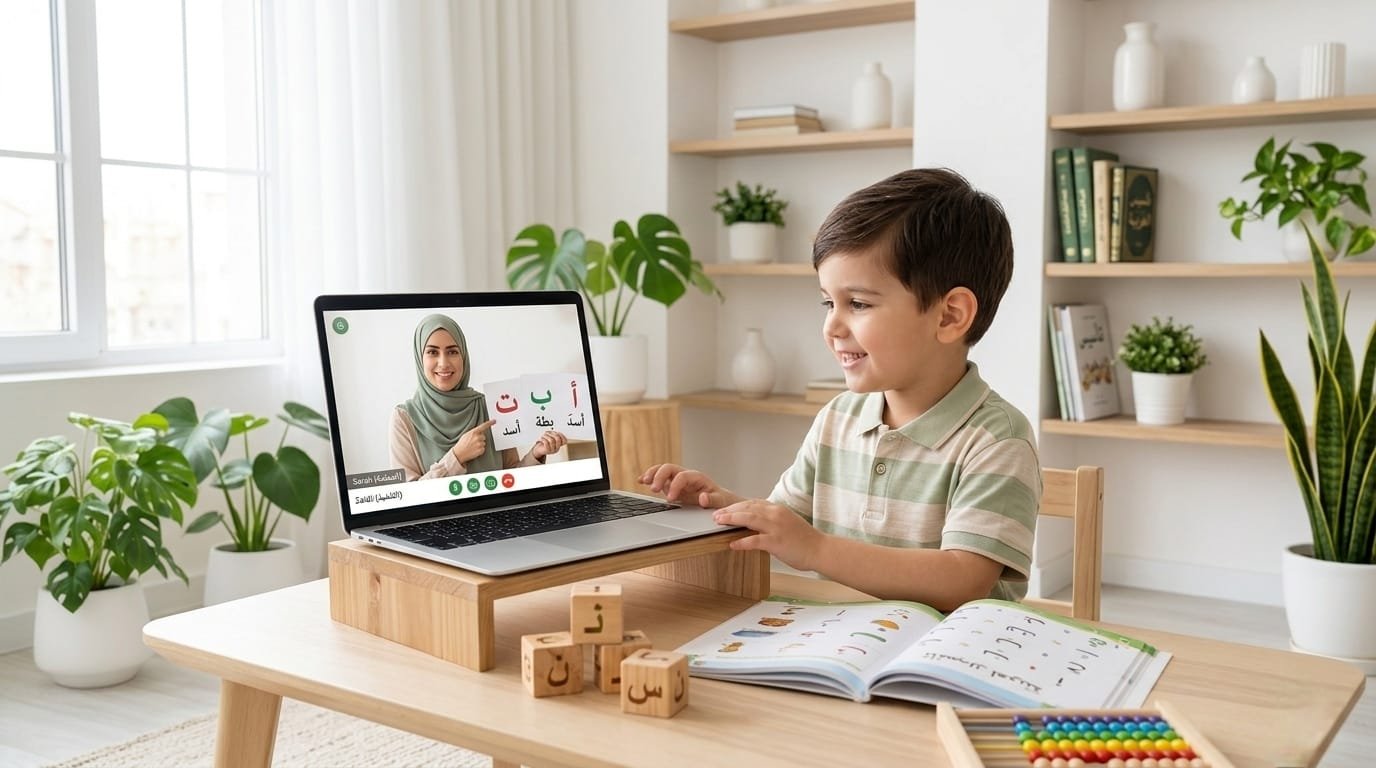
For Muslim families living in the USA and European countries, choosing the right Arabic course for kids can be difficult when children grow up speaking English or another European language at home. An online Arabic course for kids can give children a structured foundation in Arabic before they move into more advanced reading, Quran, or Islamic studies. At Taj Academy, this foundation is designed especially for children who are not native Arabic speakers, helping them become familiar with Arabic letters, sounds, words, and reading in a gradual way that fits their age and learning level.
What Is an Arabic Course for Kids?
An Arabic course for kids is a structured program that helps children learn Arabic according to their age and current ability.
For a child who does not speak Arabic at home, the first goal may not be speaking long Arabic sentences.
The child may first need to learn:
- Arabic letters.
- Letter shapes.
- Basic sounds.
- Short vowels.
- How letters connect.
- Simple Arabic words.
- Basic reading.
- Listening and pronunciation.
The exact starting point depends on the child’s previous exposure to Arabic.
A five-year-old who hears Arabic from grandparents may start differently from a ten-year-old who has never heard Arabic before.
A good course should recognize that difference.
Why Do Non-Arabic-Speaking Children Need An Arabic Course For Kids?
Children who grow up in English-speaking or European-speaking environments may have very little daily exposure to Arabic.
They may hear Arabic during prayer or at the mosque, but that is not always enough to develop strong reading skills. For some children, Arabic letters can initially look completely unfamiliar.
The child may recognize the Quran visually without understanding how the letters work.
An organized Arabic course for kids gives the child a starting point.
Why An Arabic Course For Kids Can Help
| Challenge | How The Course Addresses It |
|---|---|
| Limited daily exposure to Arabic | Gives children regular contact with the language. |
| Arabic letters may look unfamiliar | Introduces the writing system in an organized way. |
| Recognizing the Quran without understanding the letters | Helps children become more familiar with Arabic reading. |
| Learning many skills at once can feel difficult | Introduces skills gradually. |
| Lack of a clear starting point | Provides a structured beginning for Arabic learning. |
What Children Need At The Beginning
- A clear starting point.
- Regular exposure to Arabic.
- A gradual learning process.
- Organized lessons.
- Time to become familiar with Arabic reading.
The goal is not to make children learn everything immediately.
The goal is to give them a comfortable starting point for Arabic learning.
Is an Online Arabic Course for Kids Suitable for Children Living in the USA?
Yes. An online Arabic course for kids can be especially useful for Muslim families in the USA because it removes the need to depend only on Arabic classes available near the family’s home.
A family may live close to a mosque but still not find a class that matches:
- The child’s age.
- The child’s current level.
- The family’s schedule.
- The child’s learning style.
- The parents’ educational goals.
Online learning gives families access to teachers beyond their immediate local area.
For busy American families, this can also make it easier to maintain a regular weekly routine.
Can an Online Arabic Course for Kids Work for Children in Europe?
Yes. Muslim families in the UK, Germany, France, Italy, Spain, the Netherlands, and other European countries may face similar challenges.
Some children grow up speaking the local language at school and English or another language at home.
Arabic may be used mainly for religious purposes; this can create a gap between the child’s Islamic environment and their Arabic reading ability.
An online Arabic course for kids can help close that gap by giving children regular exposure to Arabic from home.
The child does not need to travel to a specialized Arabic school every week, and the lesson comes to the child.
What Should a Beginner Learn First in an Arabic Course for Kids?
A complete beginner should usually start with the basics rather than being pushed immediately into difficult reading.
The early stages may include:
- Recognizing Arabic letters.
- Learning the correct sounds.
- Understanding different letter shapes.
- Practicing short vowels.
- Connecting letters.
- Reading simple words.
- Building reading confidence.
The exact order can change according to the child’s age and previous experience.
The important principle is simple: Build one skill before adding another.
A child who understands the foundation will usually find later reading much easier.
Why Is Arabic Reading Different From Learning The English Alphabet?
Children who already know the English alphabet may assume Arabic works in the same way. It does not.
Key Differences
| Arabic Reading | English Alphabet Learning |
|---|---|
| Letters can change shape depending on their position in a word. | Letter shapes generally remain the same. |
| Some letters connect to letters around them. | Letters are not connected in the same writing system. |
| Short vowels are represented differently. | Vowels have their own written letters and patterns. |
| Arabic includes sounds that may not exist in English. | English pronunciation uses a different sound system. |
| Reading requires understanding how letters behave inside words. | Knowing individual letter names is an important early step. |
For this reason, an Arabic course for kids should not simply teach children to memorize the names of letters.
Children need to understand how the letters behave when they appear in actual words.
How Does Taj Academy Help Non-Arabic-Speaking Children Build An Arabic Foundation?
Taj Academy provides Arabic foundation learning for children who do not speak Arabic as their first language.
The Learning Process
- Begins with basic reading skills.
- Develops gradually as the child becomes more confident.
- Uses structured learning for younger students.
- Introduces Arabic reading step by step.
- Focuses on understanding what children are reading.
- Creates a foundation for later Quran reading and Islamic education.
For younger learners, a structured method such as Noor Al Bayan can help introduce Arabic reading step by step.
The purpose is not to rush children through a textbook. It is to help them understand what they are reading.
This foundation can later support Quran reading and other forms of Islamic education.
Is Noor Al Bayan Good For Children Who Cannot Read Arabic?
Noor Al Bayan can be useful as a structured starting point for children who are learning Arabic reading from the beginning.
Why It Can Be Suitable For Beginners
| Starting Point | Noor Al Bayan Approach |
|---|---|
| Child has little or no Arabic reading experience. | Begins with manageable reading steps. |
| Full Quran pages may feel overwhelming. | Introduces simpler material first. |
| Children need time to understand new patterns. | Progresses gradually. |
| Beginners need opportunities to practice. | Provides progressively more complex reading practice. |
| Early difficulty may affect confidence. | Small successes can encourage continued learning. |
Imagine asking a child who has never learned Arabic to read a full Quran page. The page may look overwhelming.
Now imagine starting with a few letters and simple combinations. The second approach gives the child something they can understand and practice.
Small successes create confidence.
What Is The Difference Between An Arabic Course For Kids And Quran Lessons?
An Arabic course for kids and a Quran course can support each other, but they are not the same.
| Arabic Course For Kids | Quran Course |
|---|---|
| Letters | Quran reading |
| Sounds | Recitation |
| Reading | Tajweed |
| Vocabulary | Memorization |
| Basic Arabic understanding | Revision |
A child who struggles to recognize Arabic letters may benefit from building Arabic reading skills first.
Another child who already reads Arabic may be ready to focus directly on Quran recitation.
The right starting point depends on the child.
Can Children Learn Arabic And Quran At The Same Time?
Yes, but the teaching plan should match the child’s ability.
A Combined Learning Approach Can Include:
- Arabic reading exercises.
- Letter recognition.
- Simple Arabic reading practice.
- Short Quran Surahs.
- Connecting Arabic reading skills with Quranic words.
The child learns Arabic and then sees the same letters in the Quran.
Over time, the Quran becomes less visually unfamiliar, and reading becomes more natural.
Why Should Parents Avoid Rushing An Arabic Course For Kids?
Parents sometimes want to see quick results.
That is understandable.
But rushing can create gaps.
| Rushing | Gradual Foundation |
|---|---|
| A child may memorize letter names without understanding word reading. | Child develops reading skills step by step. |
| Basic reading mistakes may continue. | Reading skills receive more attention. |
| Child may depend on someone else to read every word. | Child works toward greater reading independence. |
| Quick progress may hide learning gaps. | Skills are developed before moving forward. |
A slower foundation can sometimes produce faster progress later.
It is similar to building a house.
Spending more time on the foundation does not mean the project has failed. It means the structure is being made stronger.
How Long Does An Online Arabic Course For Kids Take?
There is no single timeline for every child.
Progress Can Depend On:
- Age.
- Previous exposure to Arabic.
- Number of lessons per week.
- Practice at home.
- Learning ability.
- Attention span.
- Teacher support.
- Starting level.
A child who hears Arabic at home may progress differently from a child who has never encountered the language.
Parents should therefore avoid comparing their child’s timeline with another child’s timeline.
The more useful question is: Is my child improving consistently?
How Many Arabic Lessons Should A Child Take Each Week?
For many children, regular lessons are more useful than occasional long sessions.
| Regular Learning | Occasional Long Sessions |
|---|---|
| Provides repeated exposure to Arabic. | Creates longer gaps between practice. |
| Can be easier for young children to maintain. | May be harder for children to sustain. |
| Fits more naturally into a routine. | May feel more demanding. |
| Supports consistent practice. | Can be difficult to maintain long-term. |
The ideal schedule depends on the child’s age and family routine.
Parents should choose a schedule they can maintain.
A schedule that looks perfect on paper but is impossible to follow will not produce strong long-term results.
Does An Online Arabic Course For Kids Need To Be Interactive?
Yes. Children usually learn better when they participate instead of simply listening.
A Teacher Can Ask The Child To:
- Identify a letter.
- Repeat a sound.
- Read a word.
- Match letters.
- Answer a simple question.
- Correct a mistake.
- Read aloud.
Interaction also helps the teacher understand whether the child actually understands the lesson.
A quiet child may appear to be following along while still being confused.
Direct questions reveal what the student knows.
What If My Child Gets Bored During An Arabic Course For Kids?
Boredom does not always mean the child dislikes Arabic.
The lesson may simply be:
- Too difficult.
- Too easy.
- Too repetitive.
- Not appropriate for the child’s age.
Different Children May Need Different Approaches
| Child’s Situation | Possible Learning Need |
|---|---|
| Young child | Shorter activities |
| Older child | More challenging reading |
| Visual learner | Visual learning activities |
| Child who enjoys repetition | Repeated practice and listening |
A good teacher can adjust the lesson rather than assuming the child is simply “not interested.”
Can Learning Arabic Help Children With Quran Reading?
Yes. Arabic reading skills can provide an important foundation for Quran learning.
Children who recognize Arabic letters and understand how they connect can approach Quran reading with greater confidence. However, Quran reading also requires specific skills such as correct pronunciation and recitation rules.
That is why Arabic foundation and Quran education can complement each other without being treated as identical subjects.
Families who later want their child to develop Quran reading skills can move into a dedicated learn to read Quran for kids program when the child is ready.
Why Arabic Foundation Matters For Muslim Children Growing Up In America And Europe
A Muslim child may live in an English-speaking or European-speaking society while having a religious connection to Arabic.
This creates an interesting situation.
Arabic may not be the child’s daily language, but Arabic can still be important in their Islamic life.
Where Children May Hear Arabic
- Salah.
- Quran recitation.
- Friday prayers.
- Islamic classes.
- Family gatherings.
- Religious celebrations.
Learning the language gradually can help the child feel more comfortable with these experiences.
It can also reduce the feeling that Arabic is a completely foreign language.
Should Parents Expect Their Children To Speak Arabic Fluently?
Not necessarily. The answer depends on the family’s goals.
| Family Goal | Possible Focus |
|---|---|
| Conversational Arabic | Speaking and everyday language skills. |
| Quran reading | Arabic reading foundation. |
| Both | Combination of speaking and reading skills. |
These goals require different approaches.
An Arabic foundation course can focus primarily on reading if that is what the child needs.
Parents should tell the academy what they want their child to achieve before choosing a program.
Clear goals make lesson planning much easier.
What If The Parents Do Not Speak Arabic Either?
This is common among Muslim families living outside Arabic-speaking countries.
Parents may:
- Read some Quran but not communicate in Arabic.
- Have limited Arabic knowledge.
- Not know Arabic at all.
That does not prevent their children from learning.
The Learning Roles Can Be Simple
| Teacher | Parents |
|---|---|
| Guides the child during lessons. | Support regular attendance. |
| Explains the material. | Encourage practice. |
| Corrects mistakes. | Help maintain the learning routine. |
The child does not need an Arabic-speaking parent sitting beside them for every lesson.
What matters most is having qualified instruction and a consistent learning routine.
Can An Online Arabic Course For Kids Prepare A Child For Tajweed?
It can provide part of the foundation.
A child who learns Arabic letters, sounds, and reading patterns may find later Quran recitation easier.
However, Tajweed requires its own structured instruction.
The Learning Progression
- Arabic Foundation
- Quran Reading
- Tajweed
- Advanced Quran Goals
Children eventually need to learn how be produce sounds correctly during Quran recitation and how different recitation rules are applied.
Families who want a dedicated next step can consider the Best Online Tajweed Course when the child has the appropriate reading foundation.
The important point is progression.
- First build the foundation.
- Then develop accurate Quran recitation.
- Then continue toward more advanced goals.
Is An Online Arabic Course For Kids Better Than A Local Arabic Class?
Neither option is automatically better.
A local class may be ideal for a child who enjoys group interaction and has a strong program nearby.
An online course may be better for a family that needs:
- Flexible scheduling.
- Private instruction.
- Access to specialized teachers.
- No travel.
- A program designed for non-Arabic speakers.
| Online Arabic Course | Local Arabic Class |
|---|---|
| Flexible scheduling. | Face-to-face classroom setting. |
| Private instruction may be available. | Group interaction may be available. |
| No travel required. | Physical classroom experience. |
| Access to teachers beyond the local area. | Convenient when a strong local program is nearby. |
| Can be designed for non-Arabic speakers. | Depends on the available local program. |
Parents should compare the actual learning experience rather than assuming that online or offline education is always superior.
Why One-to-One Lessons Can Help Some Children
Children do not all learn comfortably in groups.
Common Group-Learning Challenges
| Child’s Situation | Possible Challenge |
|---|---|
| Shy child | May avoid asking questions. |
| Fast learner | May become bored while waiting. |
| Child who needs repetition | May feel uncomfortable slowing down the group. |
One-to-one online lessons remove many of these problems.
Benefits Of Individual Lessons
- The teacher can focus entirely on one student.
- A child can receive additional repetition when needed.
- The teacher can move forward when the child understands a skill.
- The lesson can adjust to the child’s pace.
- The student receives more direct attention.
That flexibility can make a significant difference.
What Should Parents Look For In An Online Arabic Course For Kids?
Before enrolling, parents should ask practical questions.
| What To Ask | What Parents Should Find Out |
|---|---|
| Teacher Experience | Who will teach the child? |
| Teaching Method | How are beginners introduced to Arabic? |
| Lesson Format | Are classes live and interactive? |
| Student Level | How does the academy determine where the child should begin? |
| Progress | How do parents know whether the child is improving? |
| Schedule | Can lessons fit around school and family commitments? |
| Language | Can the teacher explain concepts in a language the child understands? |
| Next Steps | What happens after the child completes the beginner stage? |
These questions help parents choose based on educational quality rather than advertising alone.
Why Taj Academy Focuses On Children Who Need A Real Arabic Foundation
For a child growing up in America or Europe without Arabic as a home language, the first challenge is often not advanced grammar.
It is familiarity.
The child needs to become comfortable:
- Seeing Arabic.
- Hearing Arabic.
- Repeating Arabic.
- Reading Arabic.
That process takes time.
Taj Academy’s foundation-focused approach recognizes that children should not be expected to start at the same level as native Arabic speakers.
The goal is to meet the child where they are and build from there.
The Long-Term Value Of An Arabic Foundation
An Arabic course can look like a small educational step.
But its effects can extend much further.
The Learning Path
- Letters
- Words
- Quran Reading
- Pronunciation
- Tajweed
- Memorization
Years later, the child may be able to read Arabic confidently without depending on someone else.
That is why foundation work matters.
The first stage may not look impressive.
But it can influence how comfortable the child becomes with Arabic and Quran learning later.
What Is The Biggest Mistake Parents Make When Choosing An Arabic Course For Kids?
One common mistake is choosing a program based only on speed.
Parents may ask: “How quickly can my child finish the book?”
A better question is: “Will my child actually understand what they are learning?”
Other Important Considerations
- Avoid choosing a program designed for native Arabic speakers when the child has never learned Arabic.
- Make sure the curriculum does not move too quickly.
- Choose a beginner-friendly learning path.
- Pay attention to the child’s understanding and confidence.
A beginner needs a beginner-friendly path.
Why Progress Should Be Measured Over Months, Not Just Lessons
Children have good days and difficult days.
A child may read beautifully one week and struggle the next.
That does not necessarily mean progress has stopped.
Signs Parents Can Track Over Time
| Area | Question To Consider |
|---|---|
| Letter recognition | Is the child recognizing more letters? |
| Pronunciation | Are sounds becoming clearer? |
| Word reading | Can the child read words that were difficult before? |
| Independence | Does the child need fewer prompts? |
| Confidence | Is the child becoming more comfortable with Arabic reading? |
These changes are often more meaningful than what happens in one individual lesson.
The Real Goal Of An Online Arabic Course For Kids
The goal is not simply to make a child memorize Arabic letters.
It is to give the child a usable foundation.
A child who develops that foundation can:
- Continue learning.
- Read more confidently.
- Approach Quran education with less fear.
- Eventually study Tajweed.
- Build stronger connections with Islamic texts.
- Continue learning as they grow.
For families in the USA and Europe, this can be especially valuable because the child may not encounter Arabic naturally every day.
An online course creates a regular place for Arabic in the child’s life.
Can a 5-Year-Old Start an Arabic Course for Kids?
Yes. A five-year-old can begin an Arabic course for kids, but the teaching style should be very different from a lesson designed for an older child.
Young children usually need:
- Short learning activities.
- Repetition.
- Visual examples.
- Simple instructions.
- Frequent encouragement.
- A relaxed pace.
A five-year-old does not need to sit through a long explanation of Arabic grammar. At this age, the main goal is to make Arabic familiar and enjoyable.
Is an Online Arabic Course for Kids Suitable for a 6-Year-Old?
Yes, if the course is designed for young learners.
At six, many children can begin working more seriously on:
- Arabic letter recognition.
- Letter sounds.
- Short vowels.
- Simple combinations.
- Basic reading.
The teacher should still keep activities varied because young children can lose focus quickly.
A private online class can be useful because the teacher can change the activity when the child becomes tired.
Can a 10-Year-Old Start an Arabic Course for Kids From Zero?
Absolutely. Being ten years old does not mean a child is too old to begin Arabic.
In fact, older beginners can sometimes understand instructions more easily because they have stronger attention and reasoning skills.
However, the teacher should not assume that an older child knows Arabic simply because they are older.
A ten-year-old beginner may still need to start with the Arabic alphabet.
What If My Child Is 12 or 13 and Still Cannot Read Arabic?
There is no reason to treat this as a failure.
Children develop at different speeds, and some Muslim families do not have Arabic-speaking parents at home.
The important thing is to identify the child’s actual level and start there.
An online Arabic course for kids can give teenagers a structured opportunity to rebuild their foundation without making them feel embarrassed about being beginners.
Can Teenagers Still Join an Arabic Course for Kids?
It depends on the academy’s program structure.
For teenagers, a course designed specifically for younger children may not always be appropriate.
They may need more mature explanations and more challenging exercises.
The basic Arabic reading principles remain the same, but the teaching style should match the student’s age.
This is another reason parents should ask how an academy groups students before enrolling.
What If My Child Understands Arabic but Cannot Read It?
This is a very common situation.
Some children hear Arabic from parents or grandparents but never learned how to read Arabic properly.
In this case, the child may already understand many spoken words.
The teacher can focus more heavily on reading and pronunciation instead of spending unnecessary time teaching basic vocabulary the child already knows.
This can make progress faster without skipping important reading foundations.
What If My Child Can Read Arabic but Does Not Understand What They Read?
Reading and understanding are two different skills.
A child may pronounce Arabic words correctly without knowing their meanings.
That does not mean the reading work was wasted.
It simply means the child has developed one skill before another.
Parents can gradually introduce simple vocabulary and meanings after reading becomes comfortable.
For children studying Quran, this can eventually help them connect recitation with understanding.
Can Children Learn Arabic Without Speaking Arabic at Home?
Yes. Many Muslim children in the USA and Europe live in homes where Arabic is not the main language.
They can still learn through regular lessons and practice.
The main challenge is exposure.
A child who hears Arabic only during a weekly class has less exposure than a child who hears it every day.
Parents can help by adding small amounts of Arabic to daily life without forcing the child to speak it constantly.
How Can Parents Give Their Children More Arabic Exposure at Home?
Parents can create simple opportunities.
For example:
- Play short Arabic audio clips.
- Label simple household objects in Arabic.
- Practice one or two words each day.
- Read simple Arabic words together.
- Let children hear Arabic stories.
- Review letters from previous lessons.
The goal is not to turn the entire home into an Arabic classroom.
Small, regular exposure is often easier for children to maintain.
Should Parents Speak Arabic With Their Children If They Are Not Fluent?
They can use simple Arabic words they know, but parents should not feel pressured to become Arabic teachers.
If parents are unsure about pronunciation, they can leave formal instruction to the teacher.
Their role can be encouragement and practice.
For example, a parent can ask the child to identify a letter or read a familiar word.
This gives the child another opportunity to use what they learned.
What If My Child Says Arabic Is Too Difficult?
The first step is to find out why.
Arabic may feel difficult because:
- The child does not recognize the letters.
- The lesson is moving too quickly.
- The child is tired.
- The child is being compared with another student.
- The activities are not suitable for their age.
- The child has had a negative learning experience.
Parents should not immediately respond by increasing study time.
Sometimes changing the learning approach works better than adding more hours.
Should Parents Force Children to Practice Arabic Every Day?
Regular practice is useful, but constant pressure can have the opposite effect.
A child who associates Arabic with arguments may begin avoiding it.
Parents can create a predictable routine while keeping practice short.
For example, ten minutes of reading may be enough for a young beginner.
The exact amount should depend on the child’s age and level.
How Can an Online Arabic Course for Kids Keep Children Interested?
Interest usually improves when children feel that they are doing something rather than simply listening.
Teachers can ask questions, use visual materials, let children read aloud, and give them small challenges.
Progress also becomes more motivating when children can see what they could not do a few weeks earlier.
A child who once struggled to identify Arabic letters may feel proud when they can read a simple word independently.
Are One-to-One Arabic Lessons Better for Children?
They can be, especially for beginners or children who need extra support.
In a one-to-one lesson, the teacher does not need to divide attention between several students.
The teacher can spend more time on a difficult letter or move ahead when the child understands quickly.
Group classes can still work well for children who enjoy social learning.
The better option depends on the individual child.
Can an Online Arabic Course for Kids Help a Shy Child?
Yes.
Some shy children actually feel more comfortable in private online lessons because there are fewer people watching them.
The teacher can gradually encourage the child to speak and read aloud.
Once the child becomes comfortable, participation often increases.
Parents should give the teacher time to build trust instead of expecting a shy child to become highly interactive in the first lesson.
What If My Child Makes the Same Arabic Pronunciation Mistake Repeatedly?
Repetition is normal.
Some Arabic sounds are unfamiliar to children who grew up speaking English or another European language.
The teacher may need to demonstrate the sound several times.
The child may also need to practice it outside class.
Parents should avoid turning the mistake into a source of embarrassment.
Correction should feel like part of learning, not punishment.
Why Is Pronunciation Important in an Arabic Course for Kids?
Pronunciation matters because changing a sound can sometimes change the word.
Children should learn correct sounds from the beginning rather than developing habits that become difficult to correct later.
This becomes even more important when Arabic learning is connected to Quran reading.
A strong Arabic reading foundation makes future Quran recitation work easier.
Can an Arabic Course Help My Child Before Starting Quran Classes?
Yes.
For a complete beginner, Arabic reading skills can make Quran lessons less intimidating.
A child who already recognizes letters and basic vowel patterns can spend more time learning Quran recitation instead of trying to understand the alphabet at the same time.
This does not mean every child must finish a full Arabic course before touching the Quran.
The teacher should decide what foundation the individual student needs.
Should Arabic and Quran Be Taught Separately?
Not always.
They can be taught together when the child is ready.
For example, a teacher can introduce a letter through a simple Arabic exercise and later show the child that the same letter appears in a Quranic word.
This creates a connection between Arabic reading and Quran learning.
However, the teacher should avoid making the child feel that every Arabic lesson must immediately become a Quran memorization lesson.
What Is the Difference Between Arabic Reading and Quran Reading?
Arabic reading teaches the child how to recognize and pronounce written Arabic.
Quran reading adds another layer.
The student needs to apply Quranic pronunciation and recitation rules correctly.
This is why a child may be able to read a simple Arabic sentence but still need additional instruction before reading the Quran fluently.
The skills overlap, but they are not identical.
Can an Online Arabic Course for Kids Prepare Children for Quran Tajweed?
Yes, it can create an important foundation.
Children who become comfortable with Arabic letters, sounds, and connected words have an easier starting point for Quran Tajweed.
Later, they can study specific recitation rules with a qualified teacher.
A dedicated Best Online Tajweed Course can be considered when the child’s reading ability is strong enough.
Parents should avoid starting teaching Quran online and advanced Tajweed rules before the child can read basic Arabic comfortably.
Why Should Children Learn Arabic Before Advanced Quran Memorization?
They do not always have to complete Arabic studies first.
However, strong reading skills can make memorization more accurate.
A child who cannot read a verse independently may depend heavily on listening.
That can make it harder to notice their own reading mistakes.
When children can read the words themselves, they can participate more actively in memorization and revision.
Can an Arabic Course Help Children Who Memorize Quran Without Understanding Arabic?
Yes. Many children memorize the Quran through listening and repetition without understanding the Arabic language.
An Arabic foundation can gradually help them recognize words and simple meanings.
This does not mean they need advanced Arabic grammar to benefit from online Quran teaching.
Even basic vocabulary can make familiar Surahs feel more meaningful.
How Can Parents Know If an Online Arabic Course Is Actually Working?
Look for gradual changes.
Your child may:
- Recognize more letters.
- Make fewer pronunciation mistakes.
- Read words without help.
- Remember previously learned material.
- Need fewer reminders.
- Become more willing to read.
- Feel more confident during lessons.
Progress does not always appear as a dramatic jump.
Small improvements over several months are often a better sign of effective teaching.
What Should Parents Do If Progress Seems Slow?
Talk to the teacher before making a major change.
The teacher may identify a specific problem.
Perhaps the child needs more revision.
Perhaps the lesson pace is too fast.
Perhaps the child needs a different activity.
Perhaps there is not enough practice between lessons.
A slow period does not automatically mean the course is ineffective.
How Important Is the Teacher in an Online Arabic Course for Kids?
The teacher is extremely important.
Online education does not remove the need for good teaching.
In fact, the teacher’s communication skills can become even more important because they need to keep the child engaged through a screen.
Parents should look for someone who understands children’s learning behavior and can explain Arabic clearly to non-native speakers.
What Makes Taj Academy Suitable for Non-Arabic-Speaking Children?
Taj Academy focuses on helping children build Arabic and Quran foundations even when Arabic is not their home language.
The online format allows families in the USA and Europe to access structured instruction from home.
Teachers can adapt lessons to the child’s current level rather than assuming that every Muslim child already understands Arabic.
Can Children Learn Arabic While Attending an American or European School?
Yes.
The two learning systems can work together.
A child can attend school during the day and study Arabic at a suitable time in the afternoon or evening.
Online lessons can make this easier because there is no travel between school, home, and a physical Arabic center.
The key is not to overload the child with too many classes.
How Can Parents Balance Arabic, Quran, School, and Other Activities?
Start with realistic goals.
Children already have school, homework, sleep, sports, family time, and social activities.
A manageable Arabic schedule is better than an ambitious schedule that causes burnout.
Parents can discuss the weekly routine with the teacher and adjust lesson frequency when necessary.
Consistency usually matters more than trying to study everything at once.
Is It Too Late for a Child to Start an Online Arabic Course for Kids?
No. There is no specific age at which Arabic learning becomes impossible.
Older children may have different challenges, but they also have stronger attention and reasoning abilities.
The important thing is to start with the child’s actual level.
A child who starts at twelve can still develop useful Arabic reading skills with regular practice.
What Should Parents Expect During the First Few Weeks?
The first weeks are usually about adjustment.
The child is learning how the teacher explains things.
The teacher is learning the child’s strengths and weaknesses.
The child is becoming familiar with Arabic sounds and reading patterns.
Parents should not expect major results immediately.
The foundation stage is about creating a system that can support future progress.
What Is the Long-Term Goal of an Arabic Course for Kids?
The long-term goal depends on the family.
For some children, it may be confident Arabic reading.
For others, it may be Quran reading, Tajweed, Islamic studies, or eventually deeper Arabic understanding.
The most useful foundation is one that leaves the child able and willing to continue learning.
How Can an Arabic Foundation Change a Child’s Quran Journey?
A child who begins with a strong Arabic reading foundation may approach Quran learning with greater confidence.
Instead of seeing the Quran page as a collection of unfamiliar symbols, the child gradually recognizes how Arabic letters and words work.
This can make later Quran reading, Tajweed, and memorization feel more manageable.
The Arabic course is therefore not necessarily separate from the child’s Islamic education.
It can be one of the first steps in that journey.
Why does Taj Academy offer Arabic foundations for non-Arabic-speaking children?
Taj Academy helps Muslim children in the USA and European countries build Arabic reading foundations even when Arabic is not their home language. The online format allows families to access structured learning without depending only on local Arabic programs.
An online Arabic course for kids can make that foundation more accessible by allowing children to learn from home, work with experienced teachers, and follow a schedule that fits their family life.
At Taj Academy, the focus is not on making every child progress at the same speed. The goal is to meet non-Arabic-speaking children at their current level and help them build useful skills step by step.