

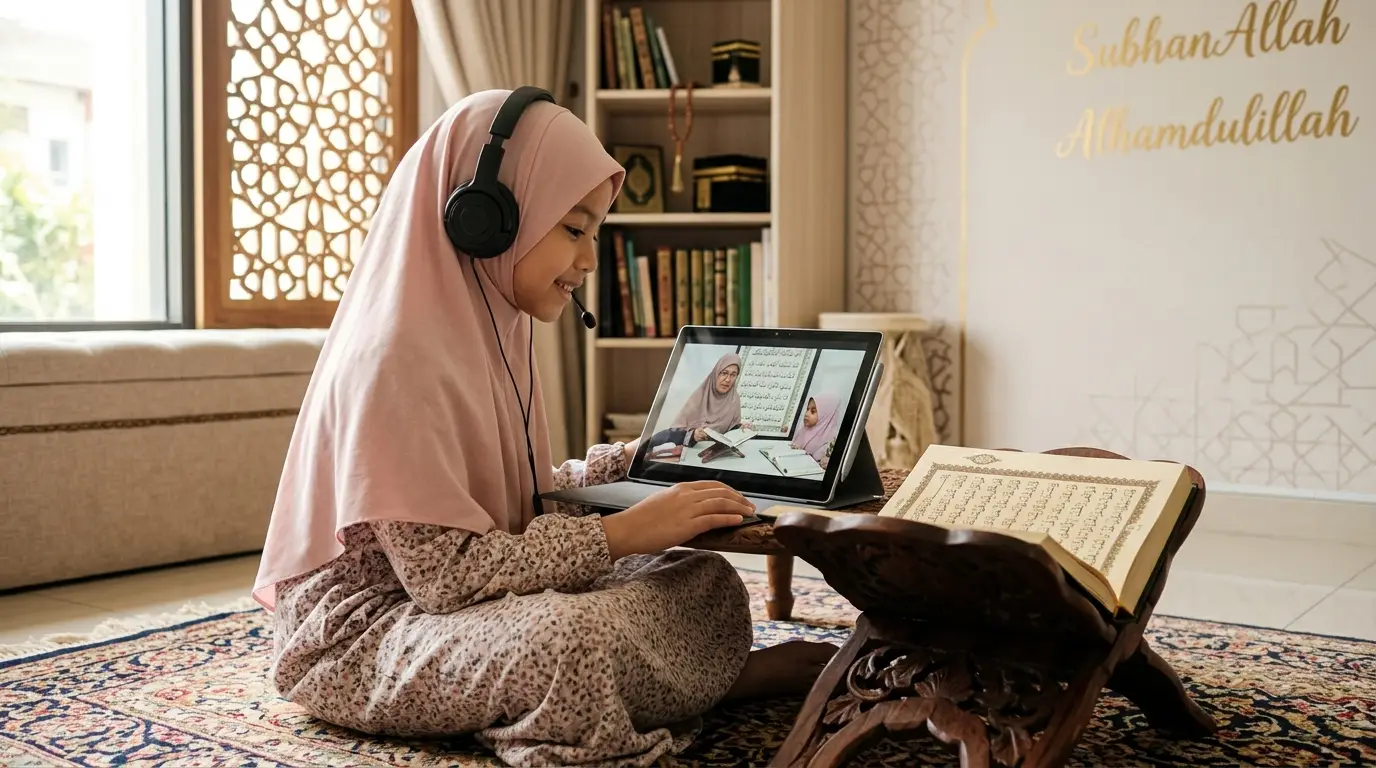
Quran Learning For Kids and Online Quran Learning For Kids have become increasingly relevant for Muslim families living in the United States. As children grow up surrounded by smartphones, tablets, online classrooms, streaming platforms, and digital communication, parents naturally ask an important question: Can the timeless teachings of the Quran fit comfortably into a modern digital lifestyle?
The answer is yes—when technology is used as a tool rather than a replacement for meaningful Islamic education. Online Quran education can give children access to qualified teachers, structured lessons, Quran memorization programs, and Tajweed instruction without requiring families to travel to a physical center every week. For busy Muslim families in the USA, this flexibility can make consistent Quran education much easier to maintain.
However, successful Quran Learning For Kids is not simply about putting a child in front of a screen. It requires the right teacher, age-appropriate teaching methods, parental involvement, engaging lessons, and a learning environment that helps children build a genuine relationship with the Quran.
This guide explores how Online Quran Learning For Kids can fit into modern American family life, what children can learn online, how parents can choose the right program, and how digital Quran education can balance convenience with the spiritual values of traditional learning.
Why Quran Learning For Kids Matters in Modern American Families
For Muslim families in the United States, raising children with a strong connection to the Quran can sometimes be challenging. Children may attend American schools, participate in extracurricular activities, play sports, use digital devices, and have busy social schedules. Finding enough time for Islamic education can therefore require careful planning.
Quran Learning For Kids provides more than the ability to read Arabic verses. A well-designed Quran program can help children develop several important skills and values.
| Area | What Children Can Develop |
| Quran Reading | Arabic letters, pronunciation, fluency, and reading confidence |
| Memorization | Surahs, selected verses, and long-term memorization habits |
| Tajweed | Correct pronunciation and Quranic recitation rules |
| Understanding | Basic meanings and age-appropriate explanations |
| Islamic Values | Patience, honesty, respect, gratitude, and responsibility |
| Spiritual Connection | Love and respect for the Quran |
| Learning Habits | Consistency, concentration, revision, and self-discipline |
For children growing up in the USA, online lessons can also help bridge the gap between their everyday environment and their Islamic education. Instead of treating Quran study as something separate from their lives, parents can create a consistent routine that works alongside school and family activities.
How Online Quran Learning For Kids Fits Into a Digital Lifestyle
Online Quran Learning For Kids is particularly suitable for families who already use technology for education. American children are familiar with video lessons, virtual classrooms, educational applications, digital assignments, and online communication.
This familiarity can make online Quran lessons feel natural rather than unfamiliar.
A typical online lesson may include:
- A live video session with a Quran teacher.
- Quran reading practice.
- Correction of pronunciation.
- Memorization or revision.
- Tajweed instruction.
- Questions and interaction.
- Homework or practice for the next lesson.
The major advantage is flexibility. A family living in New York, California, Texas, Florida, or another US state does not necessarily need to find a nearby Islamic center offering a schedule that matches their availability.
Instead, parents can select lesson times that fit around school and family commitments.
Digital Learning Does Not Have to Mean Less Personal
One common concern is that online education may feel impersonal. In reality, a live online Quran lesson can still provide direct communication between the teacher and child.
The teacher can listen to the student’s recitation, identify pronunciation mistakes, explain Tajweed rules, encourage the student, and adjust the lesson according to the child’s ability.
The quality of the experience depends less on whether the classroom is physical or digital and more on how the teacher teaches and how the program is structured.
Quran Learning For Kids vs. Traditional Quran Classes
Traditional Quran classes remain valuable for many families. Children may benefit from being physically present with teachers and other students. At the same time, online education introduces advantages that can be especially useful for families with demanding schedules.
| Factor | Online Quran Learning For Kids | Traditional Quran Classes |
| Location | Anywhere with internet access | Requires physical attendance |
| Scheduling | Often more flexible | Usually follows center schedules |
| Transportation | No commuting required | Requires travel |
| One-to-One Learning | Commonly available | Depends on the center |
| Teacher Access | Live online interaction | Face-to-face interaction |
| Family Convenience | High | Depends on location |
| Progress Tracking | Can be digitally organized | Depends on the institution |
| Suitable for Busy Families | Very suitable | May require more planning |
Neither model is automatically better for every child. The best option depends on the child’s personality, learning needs, family schedule, and the quality of the educational program.
For many families in the USA, online learning simply removes practical barriers that could otherwise make regular Quran education difficult.
How Online Quran Learning For Kids Can Build Consistency
Consistency is one of the most important elements of Online Quran Learning For Kids. A child does not need to study for several hours every day to make meaningful progress. Regular, manageable sessions can be more effective than occasional long lessons.
For example, a family might create a weekly routine like this:
| Day | Suggested Activity |
| Monday | New Quran lesson |
| Tuesday | Reading practice |
| Wednesday | Memorization |
| Thursday | Tajweed practice |
| Friday | Revision |
| Saturday | Short family Quran session |
| Sunday | Rest or light review |
The exact schedule should be adjusted according to the child’s age and school workload.
Young children may benefit from shorter sessions with frequent encouragement, while older children may be able to handle longer lessons and more independent practice.
The key is to make Quran education a predictable part of the child’s routine.
Online Quran Learning For Kids for Different Age Groups
Children are not all ready for the same teaching approach. Online Quran Learning For Kids should therefore be adapted to age, attention span, reading ability, and previous Quranic knowledge.
| Age Group | Recommended Focus | Learning Approach |
| 4–6 | Arabic letters and basic sounds | Games, repetition, visuals |
| 7–9 | Quran reading and short Surahs | Interactive lessons and practice |
| 10–12 | Reading fluency, Tajweed, memorization | Structured learning and revision |
| 13–15 | Advanced Tajweed and memorization | More independent practice |
| 16+ | Advanced recitation and deeper study | Goal-based learning |
Younger children often need variety. A teacher might combine repetition, visual examples, pronunciation exercises, and short activities.
Older students can gradually take greater responsibility for revision and memorization.
The goal is not simply to teach the same material to every child. Effective Quran Learning For Kids recognizes that every learner develops differently.
Online Quran Learning: Creating a Positive Learning Environment at Home
Online Quran learning works best when children have a dedicated environment for their lessons. The setup does not need to be complicated.
Parents can prepare:
- A quiet corner of the home.
- A reliable internet connection.
- A computer or tablet with a suitable screen.
- Headphones when necessary.
- A physical Quran if appropriate for the lesson.
- A notebook for learning notes.
- A consistent lesson schedule
Parents should also try to minimize distractions during the session.
For example, turning off unrelated notifications, keeping toys away from the learning area, and asking siblings not to interrupt can make a noticeable difference.
The goal is to communicate that Quran learning deserves attention and respect—even when the lesson happens through a screen.
Quran Academy Online: What Should Parents Look For?
Choosing a Quran Academy Online requires more than searching for the cheapest available program. Parents should evaluate the educational quality, teacher qualifications, lesson structure, communication, and suitability for children.
A good online academy should ideally offer:
- Qualified Quran teachers.
- Child-friendly teaching methods.
- Live interaction.
- Quran reading instruction.
- Tajweed education.
- Memorization support.
- Regular revision.
- Flexible scheduling.
- Progress monitoring.
- Clear communication with parents.
Taj Academy, for example, provides online Quran-related learning opportunities focused on Quran reading, memorization, and Tajweed. For families in the USA, a structured online academy can make it easier to maintain regular lessons without adding travel time to an already busy schedule.
Parents should also ask whether the teacher has experience working with children specifically. Teaching adults and teaching young learners require different communication styles.
Quran Learning For Kids and the Role of Parents
Parents remain an important part of Quran Learning For Kids, even when a professional teacher handles the lessons.
Parents do not necessarily need advanced Quranic knowledge themselves. Their role can be focused on creating the right environment and encouraging consistency.
Parents can:
- Help children attend lessons on time.
- Ask what they learned.
- Encourage daily revision.
- Celebrate progress.
- Avoid excessive pressure.
- Communicate with the teacher.
- Help establish a routine.
Positive reinforcement can be especially powerful.
Instead of focusing only on mistakes, parents can recognize improvement: completing a Surah, improving pronunciation, remembering a difficult verse, or becoming more confident while reading.
This helps children associate Quran learning with achievement and encouragement rather than fear or pressure.
Quran Memorization Online: Can Children Memorize Effectively Through the Internet?
Quran Memorization Online has become an accessible option for families who want their children to memorize portions of the Quran with structured teacher support.
Online memorization can work because the essential process remains interactive. The teacher can listen to the child recite, identify mistakes, ask the child to repeat verses, and monitor progress.
A successful memorization system usually includes three components:
| Component | Purpose |
| New Memorization | Learning new verses or Surahs |
| Recent Revision | Strengthening memorized material recently |
| Long-Term Revision | Preventing previously memorized Quran from being forgotten |
A child should not be encouraged to memorize large amounts too quickly. Quality, accuracy, and retention are more important than speed.
For younger students, memorizing shorter passages can provide early success and build confidence. As their skills improve, the amount can gradually increase.
Tajweed Course Online: Why Correct Recitation Matters
A Tajweed Course Online can help children learn how to pronounce Quranic letters and words correctly while understanding the fundamental rules of Quranic recitation.
Tajweed is not simply about making recitation sound beautiful. It helps students understand how Arabic letters should be articulated and how specific recitation rules affect pronunciation.
Online Tajweed lessons may cover areas such as:
- Makharij al-Huruf.
- Basic pronunciation rules.
- Noon Sakinah and Tanween.
- Meem Sakinah.
- Madd rules.
- Qalqalah.
- Ghunnah.
- Rules of stopping and starting.
- Practical recitation.
Children often benefit when the teacher combines explanation with immediate practice.
Rather than presenting a long theoretical lesson, the teacher can introduce one rule, demonstrate it, and then allow the child to practice it directly in Quranic verses.
This practical approach can make Tajweed easier to understand and remember.
Ijazah Course Online: When Advanced Quran Study Becomes the Goal
For older students or advanced learners, an Ijazah Course Online may represent a more specialized stage of Quranic education.
Ijazah studies are generally intended for students who have reached an advanced level and are ready for more rigorous Quran recitation or memorization study under qualified supervision.
Parents should understand that an Ijazah program is different from a basic children’s Quran class. It may require:
- Strong Quran reading skills.
- Accurate pronunciation.
- Knowledge of Tajweed.
- Consistent memorization or recitation.
- Significant practice.
- Evaluation by a qualified teacher.
Therefore, families should not choose an advanced program simply because it sounds more comprehensive. The course should match the student’s actual level and long-term goals.
Online Quran Learning For Kids and Screen-Time Concerns
One of the biggest concerns parents may have about Online Quran Learning For Kids is screen time.
This concern is understandable. Children already spend time using computers, smartphones, tablets, gaming systems, and television.
However, not all screen time has the same purpose.
A live Quran lesson is structured educational interaction rather than passive entertainment.
Parents can create a healthier balance by:
- Keeping lessons focused and reasonably short.
- Encouraging children to look away from the screen when appropriate.
- Including offline Quran reading.
- Practicing memorization without a device.
- Taking breaks between digital activities.
- Maintaining physical family activities alongside online education.
Technology should support Quran education—not become the entire learning experience.
A child can attend an online lesson, close the laptop, and then continue practicing by reading from a physical Quran or reciting from memory.
Quran Learning For Kids and Building a Connection Beyond Memorization
Quran Learning For Kids should not be reduced to memorizing words without understanding their importance.
Memorization is valuable, but children can also gradually learn age-appropriate meanings and lessons from the Quran.
For example, teachers can discuss concepts such as:
- Kindness.
- Honesty.
- Patience.
- Gratitude.
- Respect for parents.
- Helping others.
- Trust in Allah.
- Responsibility.
- Forgiveness.
When children understand how Quranic teachings relate to everyday situations, Quran education can become more meaningful.
A child who learns about kindness can connect that lesson to how they treat classmates. A child learning about honesty can understand how Quranic values apply at school and at home.
This approach helps transform Quran learning from a weekly academic activity into part of the child’s character development.
How Taj Academy Can Support Quran Learning For Kids in the USA
For families searching for flexible Quran Learning For Kids, Taj Academy offers online Quran education designed around important areas such as Quran reading, memorization, and Tajweed.
An online learning model can be particularly useful for Muslim families in the United States because children can study from home while maintaining their regular school, family, and extracurricular schedules.
Parents considering Taj Academy or another online Quran provider should evaluate the program based on their child’s specific needs.
Important questions include:
| Question | Why It Matters |
| Are teachers qualified? | Helps ensure educational quality |
| Are lessons live? | Allows direct interaction |
| Is the program suitable for children? | Children need age-appropriate teaching |
| Is Tajweed included? | Supports accurate recitation |
| Is memorization available? | Useful for students pursuing Hifz goals |
| Can lesson times be adjusted? | Helps busy US families |
| Is progress monitored? | Shows whether the child is improving |
| Can parents communicate with teachers? | Makes home support easier |
The best program is ultimately one that the child can attend consistently and enjoy while making measurable progress.
Online Quran Learning For Kids: A Practical Weekly Routine
A practical routine can make Online Quran Learning For Kids easier to maintain.
Here is an example for a school-aged child:
| Activity | Frequency | Approximate Focus |
| Live Quran lesson | 3 times weekly | Reading + teacher instruction |
| Memorization | 4–5 times weekly | New verses |
| Revision | Daily | Previously learned material |
| Tajweed practice | 2–3 times weekly | Specific recitation rules |
| Independent reading | 2–4 times weekly | Fluency |
| Family Quran time | Once weekly | Motivation and connection |
This is only an example. Some children may need fewer sessions, while others may benefit from a more intensive program.
The most important principle is sustainability.
A routine that a child follows consistently for months is usually more valuable than an ambitious schedule that becomes overwhelming after a few weeks.
Quran Learning For Kids: Common Challenges and Practical Solutions
Even a well-designed Quran Learning For Kids program can face challenges.
| Challenge | Possible Solution |
| Child loses concentration | Use shorter, interactive activities |
| Busy school schedule | Select flexible lesson times |
| Slow memorization | Reduce new material and increase revision |
| Pronunciation mistakes | Add focused Tajweed practice |
| Lack of motivation | Celebrate small achievements |
| Technical problems | Prepare backup internet/device options |
| Too much screen time | Combine online lessons with offline practice |
| Fear of making mistakes | Encourage correction without criticism |
Parents should remember that progress is rarely perfectly linear.
Some weeks may involve significant improvement, while other weeks may focus mainly on revision. This is normal.
Online Quran Learning For Kids: How to Keep Children Motivated
Motivation plays a major role in Online Quran Learning For Kids.
Children often respond well when their progress is visible.
Parents and teachers can use simple strategies such as:
- Setting achievable weekly goals.
- Celebrating completed Surahs.
- Tracking memorization progress.
- Praising improvement.
- Giving children opportunities to recite for family members.
- Connecting Quranic lessons with everyday life.
- Avoiding unnecessary comparison with other children.
It is also important to distinguish encouragement from pressure.
A child who feels constantly judged may begin to associate Quran study with anxiety. A child who feels supported is more likely to develop a long-term relationship with learning.
Quran Learning For Kids: What Makes an Online Lesson Effective?
The effectiveness of Quran Learning For Kids depends heavily on lesson quality.
An effective lesson should have a clear objective. The child should understand what they are learning and why.
For example:
Lesson Goal: Improve pronunciation of selected Arabic letters.
Lesson Structure:
- Quick review.
- Teacher demonstration.
- Child repeats the sounds.
- Practice using Quranic words.
- Reading selected verses.
- Teacher correction.
- Short revision assignment.
This structure prevents the lesson from becoming a passive video call.
The child should actively read, recite, answer questions, practice, and receive feedback.
Online Quran Learning For Kids and the Future of Islamic Education
The growth of Online Quran Learning For Kids reflects a broader change in how education works.
Digital education does not necessarily replace traditional Islamic learning. Instead, it can extend access to qualified teachers and structured programs.
For Muslim families in the USA, this can be particularly valuable because communities are geographically spread out. A family may live far from a mosque or Islamic school that offers a specialized children’s Quran program.
Online education can help reduce that geographical barrier.
At the same time, technology should be approached thoughtfully. Quran education involves spiritual, cultural, and personal dimensions that cannot be measured only through digital features.
The ideal approach combines technology with qualified teaching, parental support, consistent practice, and respect for the sacred nature of the Quran.
Quran Learning For Kids: A Simple Checklist for Parents
Before enrolling a child in an online Quran program, parents can use the following checklist:
Teacher Quality
- Does the teacher have appropriate Quranic knowledge?
- Does the teacher have experience teaching children?
- Can the teacher explain concepts clearly?
Course Structure
- Is there a clear curriculum?
- Does the program include reading?
- Is Tajweed available?
- Is memorization available?
Learning Experience
- Are lessons interactive?
- Does the child receive individual feedback?
- Is progress monitored?
Family Convenience
- Are lesson times compatible with the child’s schedule?
- Is the platform easy to use?
- Is communication with parents available?
Child Well-Being
- Is the workload age-appropriate?
- Does the child feel encouraged?
- Is there a healthy balance between learning and other activities?
This checklist can help parents make a more informed decision rather than choosing a program based solely on price or advertising.
Frequently Asked Questions About Online Quran Learning For Kids
1. Is Online Quran Learning For Kids effective?
Yes. Online Quran education can be effective when children receive live instruction from qualified teachers, practice consistently, and receive regular feedback. The quality of teaching and the child’s commitment are more important than whether the classroom is physical or virtual.
2. What age can children start Quran learning?
Many children can begin learning basic Arabic letters and Quranic sounds at a young age. However, the ideal starting point depends on the child’s attention span, language development, and readiness.
3. Can children memorize the Quran online?
Yes. Quran Memorization Online can provide structured memorization, revision, and teacher feedback. Children should progress at a sustainable pace that prioritizes accuracy and retention.
4. Can children learn Tajweed online?
Yes. A live Tajweed Course Online can teach pronunciation and recitation rules through explanation, demonstration, and direct practice.
5. Is online Quran education suitable for children in the USA?
Yes. It can be especially convenient for American Muslim families because lessons can be scheduled around school, sports, extracurricular activities, and family commitments.
6. Does online Quran learning replace Islamic education at home?
Not necessarily. Online lessons can provide structured instruction, while parents can reinforce learning through family Quran reading, discussion, revision, and everyday Islamic values.
7. How often should children attend Quran lessons?
There is no universal schedule. Three weekly lessons may work well for some children, while others may need a different frequency. Consistency and age-appropriate workload are key.
8. How can parents keep children interested in Quran learning?
Parents can encourage children through realistic goals, positive feedback, celebrating progress, and connecting Quranic lessons with real-life situations.
Give Your Child a Quran Routine That Grows With Them
Modern life moves quickly, but that does not mean timeless knowledge has to be left behind. Online Quran Learning For Kids offers Muslim families in the USA a practical way to bring regular Quran education into a digital lifestyle while maintaining the importance of meaningful learning, teacher guidance, and family involvement.
The goal should not be to make Quran learning another screen-based activity. The goal is to use technology to make access to quality Quran education easier, more consistent, and more adaptable to the realities of modern family life.
With the right teacher, structured curriculum, supportive parents, and a sustainable routine, children can learn to read the Quran, improve their Tajweed, memorize selected Surahs, and gradually develop a deeper appreciation for its teachings.
For families exploring online Quran education, Taj Academy can be considered as one option for Quran reading, memorization, and Tajweed learning. Most importantly, choose a learning environment where your child feels encouraged to learn, practice, ask questions, and grow.
A digital lifestyle does not have to compete with ancient knowledge. With the right approach, technology can become the bridge that helps the next generation stay connected to the Quran.