

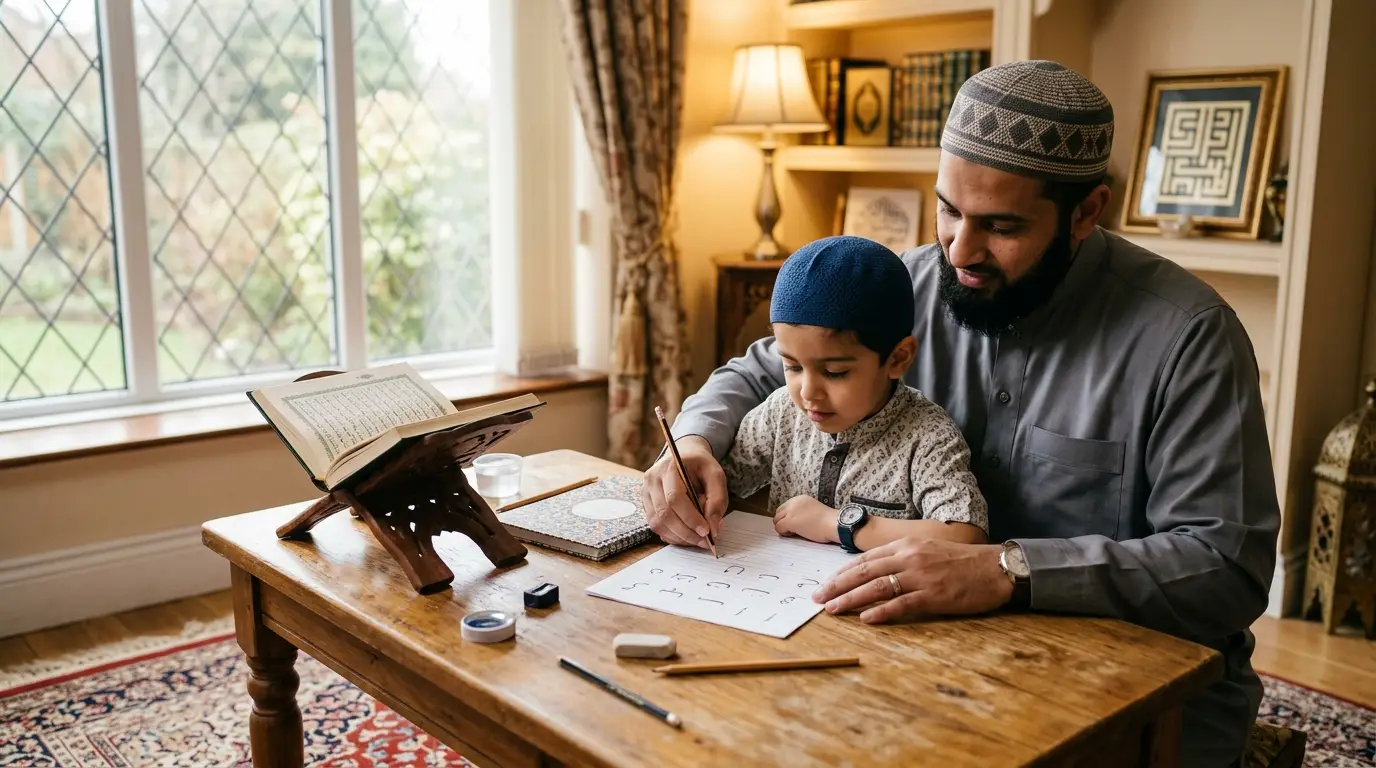
Teaching Children and Teaching Children To Write are valuable skills that can support a child’s academic development, confidence, and ability to learn independently. When these skills are connected with Quran education, children can develop stronger reading habits, improve their Arabic letter recognition, and build a more structured approach to memorization. For families in the USA looking for a meaningful online Quran learning experience, combining writing practice with Quran reading, Tajweed, and memorization can make learning more engaging and consistent.
Teaching Children through Quran-based activities is not simply about asking a child to copy letters repeatedly. It can involve listening, recognizing Arabic letters, writing them correctly, reading simple words, repeating verses, and gradually connecting written language with pronunciation. This integrated approach can help children understand what they are learning instead of relying only on repetition.
At Taj Academy, online Quran courses can give children a structured environment where Quran reading, memorization, and Tajweed lessons are adapted to their learning needs. When Teaching Children To Write is incorporated into Quran learning, parents can create a learning routine that supports several skills at the same time.
Why Teaching Children Through Quran Learning Matters
Teaching Children through Quran education can introduce them to Arabic letters and words in a meaningful context. Instead of learning isolated symbols without purpose, children can encounter letters and words while reading Quranic text, listening to recitation, and practicing pronunciation.
Teaching Children becomes especially useful when writing activities are connected with what the child is already learning. For example, a child who is learning a short Surah can practice writing selected Arabic letters or words from that Surah. This creates a connection between visual recognition, hand movement, listening, and reading.
For families in the USA, online Quran learning can also make regular practice easier to organize. A child does not necessarily need a long study session every day. Short, focused activities can gradually build familiarity with Arabic writing and Quran reading.
The Connection Between Writing, Reading, and Memorization
Teaching Children To Write can support Quran learning because writing requires children to pay attention to details. When children write Arabic letters, they need to notice their shape, position, and differences from similar letters.
Teaching Children through writing can therefore reinforce several learning processes:
- Visual recognition: Children learn to identify Arabic letters.
- Hand coordination: Writing helps develop fine motor control.
- Memory reinforcement: Repeated writing can strengthen familiarity with letters and words.
- Reading support: Recognizing written forms can make reading practice more familiar.
- Attention to detail: Children become more aware of dots, shapes, and letter positions.
- Confidence: Completing writing activities gives children a visible sense of progress.
The goal of Teaching Children is not to make writing the only method of Quran learning. Instead, writing can become one part of a broader routine that includes listening, reading, repetition, Tajweed, and memorization.
Teaching Children To Write Arabic Letters Step by Step
Teaching Children To Write Arabic should begin with simple and age-appropriate activities. Children who are new to Arabic may need time to recognize letters before they are expected to write complete words or verses.
A gradual process can prevent frustration and help children build confidence. Teaching Children works best when each stage prepares the child for the next one.
1. Start With Arabic Letter Recognition
Before expecting children to write Arabic accurately, Teaching Children should begin with identifying individual letters. Parents and teachers can introduce a few letters at a time rather than presenting the entire Arabic alphabet in one lesson.
Teaching Children To Write becomes easier when the child already knows the letter’s name and basic sound. Visual cards, tracing activities, and pronunciation exercises can make this stage more interactive.
2. Introduce Letter Shapes
Arabic letters can change their appearance depending on where they appear in a word. Teaching Children should therefore include exposure to different letter forms as the child progresses.
Teaching Children To Write can start with isolated letters before gradually introducing connected forms. This gives children time to understand how Arabic writing works without overwhelming them.
3. Use Tracing Before Independent Writing
Tracing can be a useful bridge between recognition and independent writing. Teaching Children through tracing allows children to practice the movement needed to form each letter.
Once children become comfortable, Teaching Children To Write can move toward copying letters without tracing lines. Gradually, children can begin writing familiar words independently.
4. Connect Writing With Quran Reading
Teaching Children becomes more meaningful when writing practice connects to their Quran lessons. For example, after learning a particular letter or word, the teacher can help the child identify it in a short Surah.
Teaching Children To Write can then reinforce the same material through copying selected words or practicing individual letters found in the lesson.
Teaching Children and the Development of Reading Skills
Teaching Children through writing can complement early Quran reading development. When children repeatedly see and write Arabic letters, they can become more familiar with the visual structure of the language.
Teaching Children To Write can also encourage children to slow down and observe each character. This attention can be useful when they begin reading Quranic words and distinguishing between letters that may initially appear similar.
For Quran learners, reading development involves more than recognizing letters. Children gradually need to understand how letters connect, how vowel markings work, and how words should be pronounced.
How Writing Supports Quran Reading
Teaching Children To Write can reinforce Quran reading in several practical ways:
| Writing Practice | Reading Skill It Can Support |
| Tracing Arabic letters | Letter recognition |
| Copying simple words | Word recognition |
| Writing letters with dots | Differentiating similar letters |
| Copying short Quranic phrases | Visual familiarity with Quranic text |
| Writing after hearing a word | Listening and visual association |
| Rewriting difficult letters | Accuracy and recognition |
Teaching Children can benefit from this connection because children are not learning writing and reading as completely separate subjects. Instead, both skills can reinforce each other.
Teaching Children To Write While Learning Tajweed
Teaching Children To Write can also be integrated with basic Tajweed education. Tajweed focuses on correct Quran pronunciation and recitation, while writing gives children an additional way to interact with the words they are learning.
Teaching Children can involve writing a word that contains a specific sound or letter and then practicing how that word is pronounced. This can help children connect the written form with the sound they hear from their teacher.
However, Teaching Children To Write should remain age-appropriate. Younger children may benefit from short writing exercises rather than lengthy copying assignments.
At Taj Academy, parents can consider combining Quran reading, memorization, and Tajweed instruction with simple activities that encourage children to engage with Quranic Arabic in different ways.
Teaching Children Through Short Daily Practice
Teaching Children does not need to involve long study sessions. In fact, short and consistent practice can be easier for children to maintain.
Teaching Children To Write can be included in a simple 20–30 minute routine depending on the child’s age, attention span, and learning level.
A sample routine could look like this:
| Activity | Suggested Focus |
| 5 minutes | Arabic letter review |
| 5 minutes | Writing or tracing |
| 5 minutes | Quran reading |
| 5 minutes | Memorization review |
| 5 minutes | Listening and correction |
| Optional 5 minutes | Fun writing activity |
Teaching Children through a routine like this can make learning predictable without making it feel repetitive. Parents should also adjust the routine according to the child’s individual needs.
Learn Quran For Kids: Building a Comfortable Learning Routine
When parents search for Learn Quran For Kids, they are often looking for an approach that combines Quran reading, memorization, Tajweed, and child-friendly teaching. Teaching Children can become more effective when Quran education is organized around the child’s age and current ability.
A child who is just beginning may need more time for Arabic letters and pronunciation, while an older child may already be ready for longer reading and memorization sessions. Teaching Children To Write should follow the same principle: start with the basics and increase difficulty gradually.
A comfortable learning environment can also help children stay engaged. Parents can create a quiet study area, prepare simple writing materials, and maintain a consistent lesson schedule.
Online Quran Class For Kids: Making Learning Accessible
An Online Quran Class For Kids can give families in the USA access to structured Quran lessons without requiring travel to a physical learning center. Teaching Children online can include live interaction, teacher feedback, reading practice, memorization, and Tajweed instruction.
Teaching Children To Write in an online environment may require parents to provide paper, pencils, Arabic writing worksheets, or a suitable writing board. The teacher can then demonstrate letters and ask the child to practice them during or after the lesson.
For many families, an Online Quran Class For Kids can also make scheduling more flexible. Children can attend lessons from home while maintaining their regular school and family routines.
Teaching Quran For Child Online: What Parents Should Look For
Choosing Teaching Quran For Child Online should involve more than simply looking for a convenient schedule. Teaching Children effectively requires an approach that matches the child’s age, learning level, and personality.
Teaching Children To Write may also require a teacher who understands that young learners need repetition, encouragement, and clear instructions.
Parents can consider the following factors when evaluating an online Quran program:
- Qualified Quran teachers
- Age-appropriate lessons
- Quran reading instruction
- Tajweed education
- Memorization support
- Regular progress feedback
- Flexible scheduling
- Interactive learning methods
- Individual attention
- A comfortable online learning environment
Teaching Children becomes more productive when the program does not treat every learner exactly the same.
Teaching Children To Write: Fun Activities That Reinforce Learning
Teaching Children To Write can become more enjoyable when writing activities feel like games rather than homework. Younger children often respond well to visual challenges, tracing exercises, matching games, and short creative tasks.
Teaching Children can include activities such as:
- Tracing a target Arabic letter.
- Finding a specific letter in a short Surah.
- Matching letters with their sounds.
- Writing a letter after hearing its pronunciation.
- Completing partially written words.
- Copying one or two familiar Quranic words.
- Circling a specific letter in a worksheet.
- Practicing letters with similar shapes.
- Creating simple Arabic letter cards.
- Writing a short word from the child’s current Quran lesson.
Teaching Children To Write through these activities can provide variety while still reinforcing the core learning objective.
Online Quran Memorization: Connecting Writing With Hifz
Online Quran Memorization can benefit from multiple forms of repetition. Children usually need regular review to maintain what they have memorized, and writing can become an additional reinforcement activity.
Teaching Children can include writing selected words or short portions of the Surah they are memorizing. The purpose is not to replace oral memorization but to create another connection with the material.
Teaching Children To Write can be particularly useful when a child struggles to recognize a word while reading even though they can recite it from memory. Writing the word several times may help reinforce its visual form.
A balanced memorization routine can include:
| Stage | Activity |
| 1 | Listen to the teacher’s recitation |
| 2 | Repeat the verse |
| 3 | Read the verse independently |
| 4 | Practice difficult words |
| 5 | Memorize in short sections |
| 6 | Review previous memorization |
| 7 | Write selected words or phrases |
| 8 | Recite without looking |
Teaching Children should remain focused on understanding the learning process rather than simply increasing the number of verses memorized.
Quran Academy Online: Creating Consistency at Home
A Quran Academy Online can provide structure for families who want their children to learn Quran regularly from home. Teaching Children through a structured program can make it easier to establish consistent lesson times and track progress.
Teaching Children To Write can be added as a supporting activity before or after the online lesson. For example, a child could spend a few minutes reviewing Arabic letters before beginning Quran reading.
The key is consistency. Teaching Children benefits from regular practice rather than occasional long sessions followed by extended breaks.
Parents can support this process by:
- Keeping lesson times consistent.
- Providing a quiet learning space.
- Celebrating small improvements.
- Reviewing previous lessons.
- Encouraging children without creating excessive pressure.
- Communicating with the teacher about challenges.
- Keeping writing activities short for younger learners.
Teaching Children Through Age-Appropriate Quran Activities
Teaching Children should look different at different ages. A five-year-old child may need games, tracing, repetition, and short activities, while an older child may be ready for independent writing and longer Quran reading exercises.
Teaching Children To Write should also develop gradually. The table below provides a general framework rather than a strict curriculum.
| Age Group | Teaching Children Focus | Teaching Children To Write Activities |
| 4–5 | Letters and sounds | Tracing and recognition |
| 6–7 | Basic reading | Copying letters and simple words |
| 8–9 | Reading development | Writing connected letters and words |
| 10–12 | Reading and memorization | Copying Quranic phrases |
| 13+ | Independent learning | Structured writing and Quran study |
Teaching Children should always be adapted to the individual child’s development rather than relying only on age.
How Parents Can Encourage Teaching Children At Home
Teaching Children becomes easier when parents create positive expectations around learning. Children do not need to feel that every Quran session is a test.
Teaching Children To Write can be supported through small daily activities. Parents might place an Arabic letter chart near the child’s study area or encourage the child to write one or two words from the day’s lesson.
Simple encouragement can make a difference. Teaching Children should focus on progress rather than perfection, particularly during the early stages.
Parents can use phrases such as:
- “Let’s practice this letter together.”
- “You remembered that letter from yesterday.”
- “Try writing it one more time.”
- “Let’s find this word in the Surah.”
- “You are getting more comfortable with Arabic writing.”
Teaching Children works best when children associate learning with encouragement and achievable challenges.
Common Teaching Children To Write Mistakes to Avoid
Teaching Children To Write can become frustrating if parents expect too much too quickly. One common mistake is asking a beginner to copy long Quranic passages before they are comfortable writing individual letters.
Teaching Children should also avoid excessive correction. Correcting every small mistake immediately may interrupt the child’s confidence and concentration.
Other mistakes include:
- Starting with difficult words.
- Giving children lengthy worksheets.
- Ignoring proper pencil control.
- Focusing only on writing while neglecting reading.
- Expecting perfect handwriting immediately.
- Skipping regular review.
- Comparing one child’s progress with another.
- Making every activity feel like an examination.
Teaching Children To Write should be gradual, supportive, and connected to the child’s overall Quran learning journey.
Teaching Children and Long-Term Quran Learning Skills
Teaching Children can contribute to skills that extend beyond a single Quran lesson. Learning to recognize Arabic letters, follow written text, listen carefully, and reproduce what has been learned can encourage disciplined study habits.
Teaching Children To Write also gives children an opportunity to practice concentration and patience. These habits can support Quran reading and memorization while also complementing their broader educational development.
The objective is not simply to produce perfect handwriting. Teaching Children should help children become increasingly comfortable interacting with Quranic text and participating actively in their learning.
Why Combining Writing, Reading, Tajweed, and Memorization Works
Teaching Children becomes more comprehensive when several learning methods work together. A child can listen to a verse, repeat it, read it, write selected words, and then review it during memorization.
Teaching Children To Write adds a visual and physical component to this process. Instead of relying on only one form of repetition, children interact with the same material in multiple ways.
A balanced Quran learning model may include:
| Learning Method | Main Purpose |
| Listening | Builds familiarity with pronunciation |
| Reading | Develops Quran reading ability |
| Writing | Reinforces visual recognition |
| Repetition | Supports retention |
| Tajweed | Improves recitation accuracy |
| Memorization | Builds familiarity with selected Quran passages |
| Review | Helps maintain previous learning |
Teaching Children through this combined approach can make Quran education more structured and engaging for young learners.
Teaching Children With Taj Academy
For families in the USA looking for structured online Quran education, Taj Academy provides an opportunity to learn Quran through online lessons focused on areas such as Quran reading, memorization, and Tajweed.
Teaching Children through Taj Academy can be organized around the child’s current level, while Teaching Children To Write can be used as a complementary activity to reinforce Arabic letter and word recognition.
The most effective routine will depend on the child’s age, previous Quran experience, learning speed, and personal needs. Parents can discuss these factors with the academy when establishing a suitable learning path.
Teaching Children To Write: A Simple Weekly Plan
Teaching Children To Write can become easier when parents follow a simple weekly structure rather than creating complicated daily assignments.
Teaching Children can use the following example:
| Day | Quran Focus | Writing Focus |
| Monday | New letters or reading | Trace target letters |
| Tuesday | Quran reading | Copy simple words |
| Wednesday | Tajweed practice | Identify target letters |
| Thursday | Memorization | Write selected words |
| Friday | Reading review | Independent writing |
| Saturday | Memorization review | Fun Arabic activity |
| Sunday | Light review | Optional practice |
Teaching Children should not necessarily involve writing every day for the same amount of time. Some children may need more reading, while others may benefit from additional writing practice.
Helping Children Stay Motivated
Teaching Children requires patience because children can have different levels of motivation from one day to another. A child may enjoy writing one week and prefer reading activities the next.
Teaching Children To Write can remain engaging when parents vary the activities and celebrate progress. Small achievements, such as correctly writing a difficult letter or recognizing a word independently, can be meaningful milestones.
Parents should remember that Teaching Children is a long-term process. Consistency is often more valuable than trying to accomplish too much in a single lesson.
Frequently Asked Questions About Teaching Children
Is Teaching Children To Write Arabic important for Quran learning?
Teaching Children To Write Arabic can support familiarity with Arabic letters, words, and Quranic text. However, writing should complement rather than replace Quran reading, listening, Tajweed, and memorization.
When should Teaching Children begin with Arabic writing?
Teaching Children can begin with simple letter recognition and tracing when a child is developmentally ready. Teaching Children To Write should then progress gradually toward independent letters, words, and more advanced exercises.
Can writing help children memorize Quran?
Teaching Children through writing may reinforce visual familiarity with the words being memorized. Teaching Children To Write can be used alongside listening, repetition, recitation, and regular memorization review.
Is an online Quran class suitable for children in the USA?
Teaching Children through an online Quran class can be convenient for families in the USA because lessons can take place from home. Teaching Children To Write can also be incorporated as a supporting activity using worksheets or writing exercises.
How long should children practice writing?
Teaching Children To Write should be age-appropriate. Younger children may benefit from short sessions of around 5–10 minutes, while older children may be comfortable with longer structured activities depending on their concentration and learning level.
Should writing replace Quran memorization?
Teaching Children To Write should not replace Quran memorization. Writing is best viewed as a complementary learning activity that can support reading, recognition, and retention.
Ready to make Quran learning a meaningful part of your child’s routine? Explore Taj Academy’s online Quran learning options and give your child a structured path to grow in reading, memorization, Tajweed, and Arabic skills.